Page 92
Notes
Some AVR devices do not support page by page
programming. In such a case, the SVF file must be
created without the -mp parameter.
Lattice CPLD Programming
SVF file can be created from a .JED file using ispVM
System. This program is part of the ispLEVER Classic
system, which is available at the Lattice website.
Altera CPLD Programming
The QUARTUS II program by Altera can generate SVF files
if it is set up so in the menu.
Such an SVF file, however, cannot be used as it is due to
a wrong Silicon ID. According to Altera, SVF files
generated by their software are assumed only for ATE
(Automatic Test Equipment) programmers and Altera
does not consider supporting others.
However, such an SVF file can be manually modified to
suit our needs. In order to do so, delete the "CHECKING
SILICON ID" section in the SVF file or mark it as a non-
executable comment.
State of .svf File
Implementation
The SVF file support has been implemented in accordance
with the "Serial Vector Format Specification, Revision E"
available at www.asset-intertech.com/support/svf.html
with the following limitations:
• PIO a PIOMAP commands are not implemented.
• HDR+SDR+TDR / HIR+SIR+TIR length is limited to
2^31 bits.
• Supported TCK frequencies are 3MHz, 1.5MHz,
750kHz and fragments of 1MHz starting at 500kHz
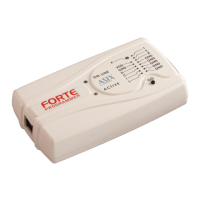
for PRESTO. FORTE adds 15MHz, 10MHz and 5MHz
on top of these.
• RUNTEST MAXIMUM max_time SEC parameter is
ignored.
• UNTEST run_count is limited to 2^31/3 (approximately
715million).
• RUNTEST min_time SEC is limited to 2^31/3ms
(approximately 715seconds).
• TRST and RUNTEST SCK – these commands share the
same configurable P/VPP pin of both the PRESTO and
FORTE programmers and can never be used together.
8.1.2 XSVF File
XSVF (Xilinx Serial Vector Format) is a file used for
describing high-level operations on the IEEE1149.1 bus
extended by Xilinx.
XSVF is recommended for Xilinx CPLD XC9500.
Examples of How to Create
XSVF Files
Xilinx CPLD Programming
To create an XSVF file, use the iMPACT program available
at the Xilinx website.
Choose Prepare Configuration Files ➙ Boundary-
Scan File ➙ XSVF File in the Operation Mode
Selection dialog window that opens after the iMPACT
program starts. Run all operations (Erase, Program,
Verify, Test...) the same way as if a programmer was
connected (e.g. Xilinx Parallel Cable). Then save the new
file and close iMPACT. Running the created XSVF file will
perform the recorded operations.
We do not recommend using an SVF file for
programming devices of the Xilinx XC9500 family, as the
algorithm for XC9500/XL/XV device programming cannot
be correctly described in the SVF format.


 To Next Page