Surround Mode Selection
One of the most important features of the AVR21EN is its
ability to reproduce a full multichannel sound field from
digital sources, analog matrix surround-encoded programs
and standard stereo programs.
Selection of a surround mode is based on personal taste,
as well as the type of program source material being used.
For example, motion pictures or TV programs bearing the
logo of one of the major surround-encoding processes (such
as Dolby Surround or DTS Stereo) may be played in either the
Dolby Digital, Dolby Pro Logic II Cinema, Dolby Pro Logic IIx
Cinema, DTS Neo:6 Cinema, or Logic 7 Cinema surround
mode, depending on the source material.
NOTE: Once a program has been encoded with matrix surround
information, it retains the surround information as long as
the program is available in stereo. Thus, movies with surround
sound may be decoded via any of the analog surround modes,
such as Dolby Pro Logic II or IIx Cinema, Logic 7 Cinema or
DTS Neo:6 Cinema, when they are broadcast via conventional
TV stations, cable, pay-TV and satellite transmission. Also, a
growing number of TV programs, sports broadcasts and radio
dramas are being recorded in surround sound.
Even when a program is not listed as carrying intentional
surround information, you may find that the Dolby Pro Logic II,
Logic 7 Enhanced or DTS Neo:6 and the Hall or Theater modes
often deliver enveloping surround presentations through the
use of the normal information present in all stereo recordings.
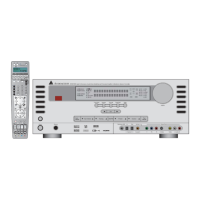
Surround modes may be changed at any time by using either
the front panel or remote control. To select a new surround
mode from the front panel, first press the
Surround Mode
Group Selector Button 3
until the desired major surround
mode group such as Dolby, DTS or Logic 7 is selected. Next,
press the
Surround Mode Selector Button 4 to choose the
specific individual surround mode.
To select a surround mode using the remote, after pressing
the
AVR Button 4, press the Surround Button C repeatedly
until the surround mode group that includes the mode you
wish to choose (Dolby, DTS Digital, DTS Neo:6, Logic 7,
Stereo or DSP Surround) appears in the lower display line
and in the on-screen display. The first press of the button
will show the current mode from that group, if it is already
in use, or the first available mode, if you are currently using
another mode. To cycle through the available modes in that
group, press the
⁄
/
¤
Navigation Button F until the desired
mode appears in the
Lower Display Line , and in the
on-screen display.
The Dolby Digital, Dolby Digital EX, DTS 5.1, DTS-ES
®
Matrix
and DTS-ES Discrete modes may only be selected when a
digital input is in use. In addition, when a digital source is
present, the AVR21EN will automatically select and switch
to the correct mode, regardless of the mode that has been
previously selected. For more information on selecting digital
sources, see the
Digital Audio Playback section (below).
128
System Operation
When the 6-channel/8-channel direct inputs are in use, there
is no surround processing, as these inputs take the analog
output signals from an optional, external DVD-Audio or SACD
player, or another source device, and carry them straight
through to the volume control.
To listen to a program in traditional 2-channel stereo, using
the front left and front right speakers only (plus the sub-
woofer, if installed and configured), from the remote, first
press the
AVR Button 4, then repeatedly press the Surround
Button C
until SURR. OFF appears in the Surround Mode
Indicators and
2 CH STEREO appears in the AVR Lower
Display Line
. From the front panel, press the Surround
Mode Group Selector 3
until the Stereo modes appear in
the on-screen display and
Lower Display Line . Next, press
the
Surround Mode Selector Button 4 until SURR. OFF
appears in the Surround Mode Indicators and 2 CH
STEREO appears in the on-screen display and AVR
Lower
Display Line
.
Digital Audio Playback
Digital audio is a major advancement over analog surround
processing systems. It delivers up to six discrete channels,
and each channel reproduces full-frequency range (20Hz to
20kHz) and offers dramatically improved dynamic range
and significant improvements to signal to-noise ratios. In
addition, digital systems have the capability to deliver an
additional channel that is specifically devoted to low-frequency
information. This is the “.1” channel referred to in systems
described as “5.1,” “6.1” or “7.1.” The bass channel is separate
from the other channels, but since it is intentionally bandwidth-
limited, sound designers have given it that unique designation.
Dolby Digital
Dolby Digital is a standard part of DVD and high-definition (HDTV)
broadcasts, and is available on specially encoded LD discs and satel-
lite broadcasts.
An optional, external RF demodulator is required to use the
AVR21EN to listen to the Dolby Digital soundtracks available on
laser discs. Connect the RF output of the LD player to the demodu-
lator and then connect the digital output of the demodulator to
the
Optical C or Coaxial Inputs F of the AVR21EN. No
demodulator is required for use with DVD players or DTS-encoded
laser discs.
DTS
DTS is a digital audio system capable of delivering 5.1 or 6.1 dis-
crete or matrix sound field reproduction. Although both DTS and
Dolby Digital are digital, they use different methods of encoding
the signals, and thus they require different decoding circuits to
convert the digital signals back to analog.
DTS-encoded soundtracks are available on select DVD and LD discs,
as well as on audio-only DTS discs. You may use any LD or CD player
equipped with a digital output to play DTS-encoded discs with the
AVR21EN. All that is required is to connect the player’s output to
either an
Optical C or Coaxial Inputs F on the AVR’s rear
panel or front panel.


 To Next Page
 Loading...