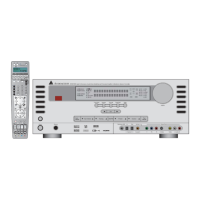
You are now ready to power up the AVR21EN
to begin these final adjustments.
1. Make certain that the AC power cord is firmly inserted into the
AC Power Cord Jack and plug the cord into an unswitched
AC outlet. To maintain the unit’s safety rating, DO NOT replace
the power cord with one that has lower current capacity.
2. Locate the
Main Power Switch and push it in until it latches.
Note that the LED in the
Standby/On Button 1 will turn red,
indicating that the unit is in the Standby mode.
3. Carefully remove the protective plastic film from the front-panel
lens. If left in place, the film will prevent proper operation of the
remote control.
4. Install the four supplied AAA batteries in the remote, as shown.
Be certain to follow the (+) and (–) polarity indicators that are in
the battery compartment.
Figure 36.
AVR21ENR1 Remote Battery Compartment
5. Turn the AVR21EN on by pressing the Standby/On Button 1
on the AVR front panel, or via the remote by pressing the Power
On Button 1
, the AVR Selector 4 or any of the Input
Selectors 3
on the remote. The LED in the Standby/On
Button 1
will turn green to confirm that the unit is on.
Using the On-Screen Display
When making the following adjustments, you may find it easier
to use the AVR21EN’s on-screen display system. These easy-to-read
displays give you a clear picture of the current status of the unit
and make it easy to see which speaker, delay, input or digital
selection you are making.
To use the on-screen menus, make certain that you have made
a connection between either the
Monitor Component Video
Outputs
or the Video Monitor Outputs and the matching
inputs on your TV, display or projector. In order to view the menus,
make certain that the proper video input type has been selected
on the display, and that any configuration required for the display,
such as selection of interlace or progressive scan, has been made.
To take advantage of the AVR21EN’s advanced video circuitry,
when a component video connection is in use, make certain that
the display is configured for “480p, 720p or 1080i,” if available.
Figure 35.
Surround & Rear Speaker Positioning
Surround & Rear Speaker Positioning
When the AVR21EN is used in 5.1-channel operation, the preferred
location for surround speakers is on the side walls of the room,
no more than 10 degrees off axis from the listening position. In a
7.1-channel system, both side surround and back surround speakers
are required. The center of the speaker should face into the room.
Rear surround speakers are required when a full 7.1-channel system
is installed, and they may also be used in 5.1-channel systems as an
alternative mounting position when it is not practical to place the
main surround speakers on the sides of the room. Speakers may be
placed on a rear wall, behind the listening position. When placing
surround speakers, it is recommended that they be located so that
none of the speakers is more than 2 feet higher than the other.
If dipole-type speakers are used on either the side or rear walls of
the room, please note that if there are arrows on the speakers,
they should face the front of the room for the side speakers, or
face toward the center of the wall for the rear speakers.
Subwoofers produce nondirectional sound, so they may be placed
almost anywhere in a room. Actual placement should be based on
room size and shape and the type of subwoofer used. One method
of finding the optimal location for a subwoofer is to begin by
placing it in the front of the room, about 6 inches from a wall,
or near the front corner of the room. Another method is to
temporarily place the subwoofer at your normal listening position,
and then walk around the room until you find a spot where the
subwoofer sounds best. Place the subwoofer in that spot. You
should also follow the instructions of the subwoofer’s manufacturer,
or you may wish to experiment with the best location for a
subwoofer in your listening room.
System Setup
Once the speakers have been placed in the room and connected,
the remaining steps in the setup process are to configure system
and source settings, program the AVR21EN for the type of speakers
used in your system, set the delay times used by the surround
sound processor and configure the output settings.
52
System Setup


 To Next Page
 Loading...