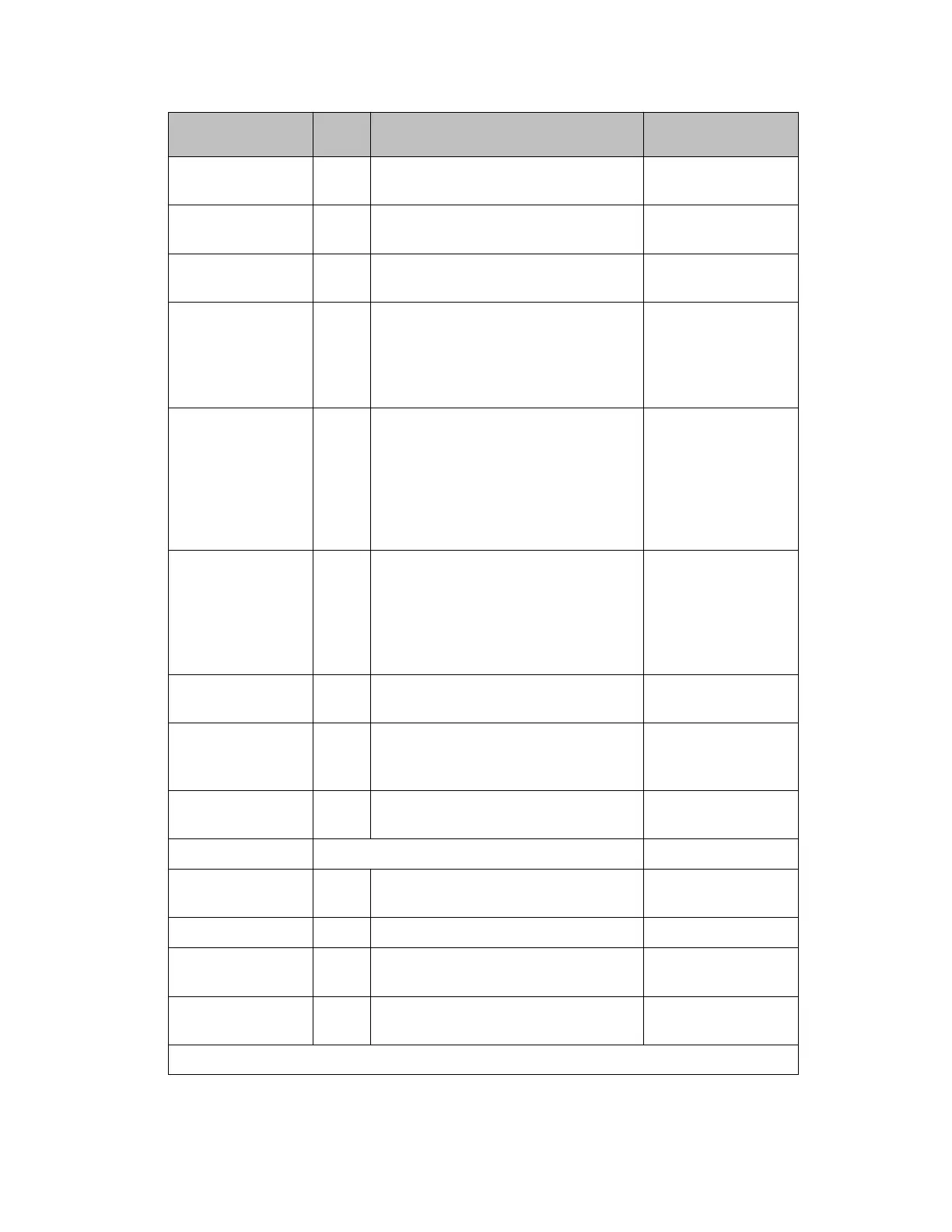
Field Label Description From the CLI
example
Combined with long RTT, a large jitter
value may indicate WAN congestion.
#jitter-event 42 The RTP receiver network jitter event
counter
Jitter 0mS #0
42
Avg-Jitter 43 The average of all network jitter values
during the session
Avg-Jitter 0mS
TTL (last/min/max) 44 The last value of TTL, minimum value
of TTL, and maximum value of TTL
sampled during the session. TTL
changes during a session may indicate
route flaps in the IP network.
TTL(last/min/max)
63/63/63
Duplicates 45 This counter increments each time two
consecutive RTP packets with the
sample RTP sequence number are
received. A large number of duplicates
may indicate problems in the Layer 2/
Ethernet topology (for example,
loops).
Duplicates 0
Seq-Fall 46 This counter increments each time an
RTP packet with a sequence number
less than the last known sequence is
received. Packet resequencing may
be caused by switching to a backup
WAN interface or route flaps.
Seq-Fall 0
DSCP 47 The last received DSCP value of the
RTP packets
DSCP 46
L2Pri 48 The last received Layer 2 priority value
of an RTP packet (usually
IEEE802.1p)
L2Pri 12
RTCP 49 The total number of received RTCP
packets
RTCP 54
Transmitted-RTP:
VLAN 50 The VLAN-ID on which the RTP
packets are transmitted
VLAN 1
DSCP 51 The DSCP of RTP packets DSCP 184
L2Pri 52 The Layer 2 priority of transmitted RTP
packets (usually 802.1p)
L2Pri 6
RTCP 53 The total number of transmitted RTCP
packets
RTCP 62
Remote-Statistics:
Monitoring applications
Administering Avaya G430 Branch Gateway October 2013 365



 To Next Page