2. General
2.4 Installation process o verview
Let the projector acclimatise after unpacking. Neglecting this may result in a startup failure of the light pro-
cessor unit.
Set up from A to Z
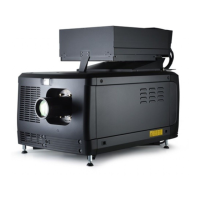
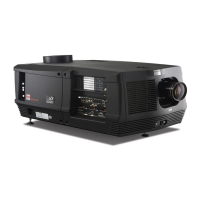
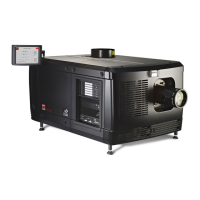
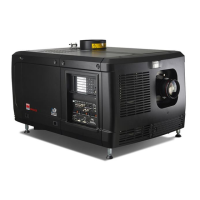
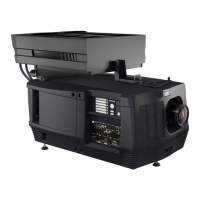
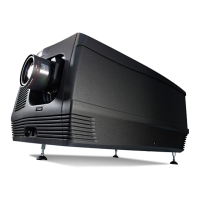
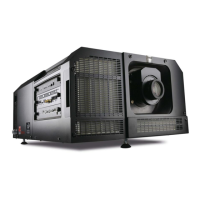
After you have unpacked and chec ked the projector y ou can start with the installation process of your DP2K-32B. This chapter gives
you an overview of all the different stages in the installation process which y ou have to follow to set your DP2K-32B up and running.
Each stage is br iefly described and refers to more detailed step by s tep procedures in this manual. Use this ov erview as a checklist
to e nsure that you h ave followed all stages in the setup process of your DP2K -32B.
Set up from A to Z
1. C heck if all installation requireme nts a re fulfilled such as the environment cond itions of the installation area, capacity of the
exhaust system, elec trical facilities, etc. Note that a solid pedestal is required to support the projector head. For more info see
chapter "Installation requirements", page 1 0.
2. Ph ysical installation o f the projector u pon its pede stal and connecting the air outlet of the projector with the exhaus t sy stem.
Note that the e xhaust system is M ANDATORY. See chapters "Positioning the DP2K -32B at port window", page 18, and "Instal-
lation of the exhaust s ystem ", page 21.
3. Po wer input set u p and Electrical connection with the power net. See chapter "Power input s etup", page 24 and "Connecting
the projector with the power net", pa ge 26.
4. Installation of a suitable UPS unit or bypass the power in and outlet for the projector electronics. See chapters "Power loop
through to the projector electronics", page 28 or "Connecting a UPS to the projector electronics", page 29.
5. Installation of the xenon lamp in ca se the xe non lamp is not install
ed in the lamp hous e y et. To install the xenon lamp the lamp
house has to be removed from the projector. To install the x enon lamp correctly and in a safe manner, see the detailed step by
step procedures in the chapter "Installation of the xenon bulb lamp", page 40.
6. Installation of t he lens. First s elect an appropriate lens which throw ratio cov ers the screen s ize and the pro jector - screen
distance. Then install the lens in the lens holder of the projector. For more information about available lenses, lens selection and
lens installation see chapter "Lens installation", page 55.
7. Installation o f the Communicator Touch Panel. See chapter "Com munic ator Touch Panel", pa ge 73.
8. A lignment of the p rojected image on the screen. The p rojector can now be switched on to project its first image (test pattern)
on the screen. Then the image can be a ligned with the screen s ize of the application. Follow the next steps to ach ieve that:
a) P lace the ON/OFF switch of the projector in the ”I” position. A
s a result the pro jector starts to initialize. Th e status lights of
the projector lights up GRE EN once the projector is initialized.
b) P ress the STANDBY bu tton on the local keypad to activate the lamp.
c) P ress the DO WS ER button on the loca l keypad to open the dows er of the projector. The dowser is open if the color of the
DOWS ER bu tton is GREEN.
d) Press the TEST PATTERN button on the local keypad to project one of the internal test patterns of the projector on the screen.
e) Us e the lens ZOOM, SHIFT and FOCUS buttons on the loca
l keypad the m atch the projected image with the screen. Tilt the
projector in case you can not SHIFT the image completely upon the screen. See "Lens shift, zoom & focus", page 58.
9. R esetting the lam p parameters. The “LAMP INFO” parameters which are stored on the con troller board of the projector MUST
be updated after each installation of an xenon lamp inside the lamp house. Neglecting this update will result in poor performance
and short life time of the xenon lamp . See chapter "Resetting the lam p pa rameters", page 47.
10.R ealignment of the xenon lamp in its reflector. For optimal performance of the xenon lam p it is required to realign the lamp
after installation in th e lamp house. See "Realignment of the lamp in its reflector", pag e 48 for more information.
11. Adjusting the light path. Normally the lens holder and the convergence of the projector is perfectly a djusted at the factory.
Nevertheless, some applications require a readjustment of the lens holder, convergence or both. See procedure "Scheimpflug
adjustment", page 59, to adjust the Scheimpflug and see chapter "Convergence", page 119 to a djust the c onvergence of the light
path.
12.Registration of the projector.TheDP
2K-32B is DCI com pliant and should be registered by Barco. Therefore, the digital c ertifi-
cate inside the projector will be us ed to secure encryption key com mun ication between the projector and the rest of the theatre
system (server and theatre management system). For more info see chapter "Projector registration", page 83.
13.Projection of a digital cinema movie. Apply a single or dua l channel SMPTE or DVI source to the input ports of the projector
and start up the projector. See "Source input ports of the DP2K-32B projector", page 70 and chapter "Starting up", page 79. Us e
the Comm unicator Touc h P anel to configure the applied source. See the user guide of the C omm unicator Touch Panel for mo re
detailed information.
16 R59770491 DP2K-32B 30/04/2010


 To Next Page