Site~Rite
®
8 Ultrasound System Page 26
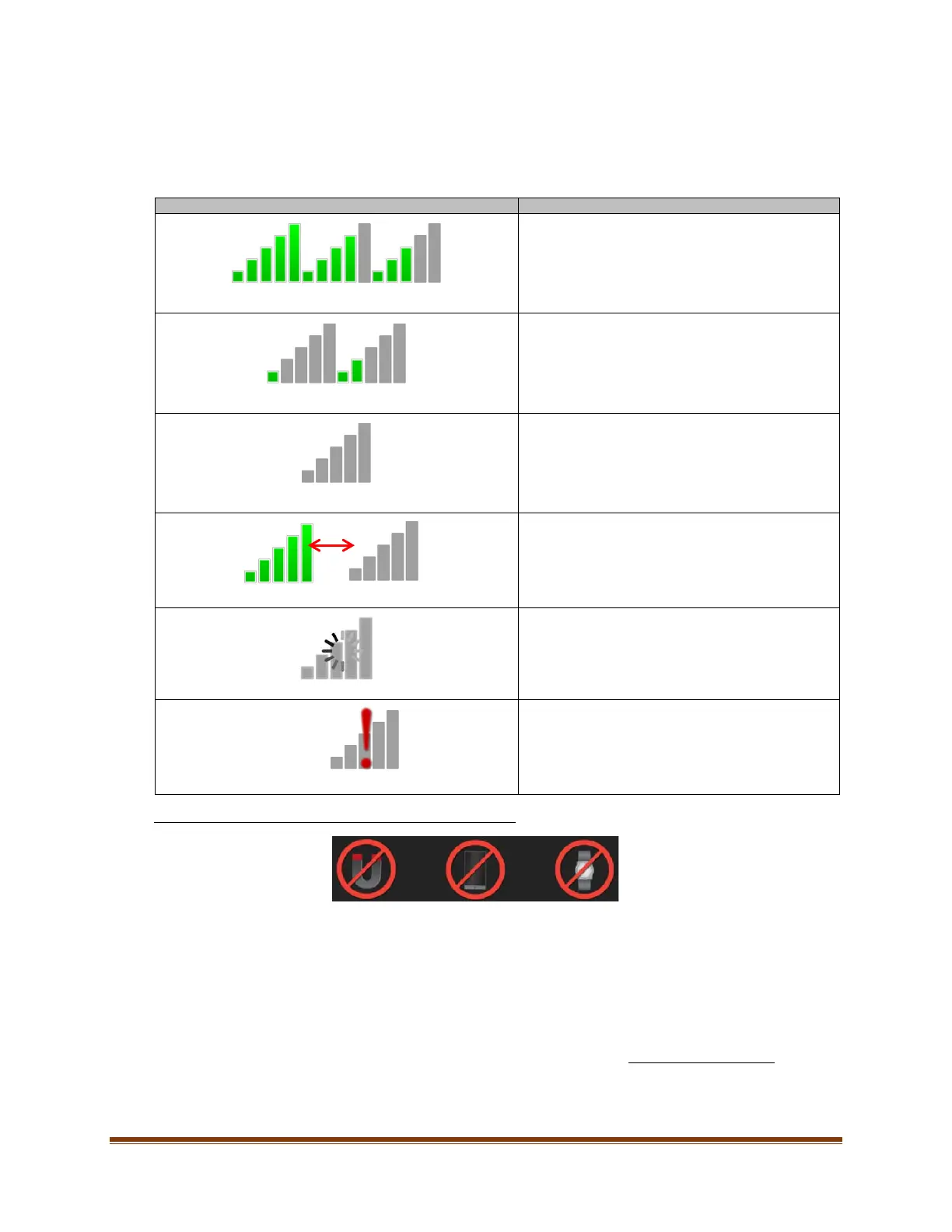
9.3.2. Performance Indicator
The Performance Indicator measures the quality of the magnetic environment around the probe. Stray magnetic
fields can inhibit the probe’s ability to detect an activated needle. More bars indicate a “cleaner” magnetic
environment for detecting an activated needle.
Low magnetic fields are present. Conditions are
optimal for the Cue™ Needle Tracking System.
Moderate magnetic fields are present. Conditions are
moderate for the Cue™ Needle Tracking System.
Strong magnetic fields are present. Conditions are
poor for the Cue™ Needle Tracking System, and
needle tracking is disabled.
The system is detecting probe movement. Hold the
probe still and wait for the Performance Indicator to
stop blinking.
The system is restarting the Cue™ Needle Tracking
System in order to load in a new needle or to recover
from an error. Please wait until the loading is complete.
Loading Cue™ Needle Tracking System
The Cue™ Needle Tracking System has encountered
an error. Refer to Section 16.2.
Cue™ Needle Tracking System Error
Perform the following steps to improve the Performance Indicator:
1. Hold the probe still
2. If the Performance Indicator decreases during needle approach, withdraw the needle and slowly re-approach.
3. Remove metal, magnetic, and electronic objects in close proximity to the probe (bed rails, jewelry, mobile phone,
pumps, bed/table frames, Cue™ Activator, etc.).
4. If problem persists, hold the probe stationary in the air away from all metal, magnetic, and electronic devices.
a. If the Performance Indicator improves, review previous troubleshooting tips
b. If the Performance Indicator remains low, calibration may be required. This should be uncommon (see
Section 11.2.1).



 To Next Page