Mechanical Dock Leveler – M and FMC Group 06, Section 02, Page 3
Issue Date: 10/01/01, Rev, 0 (Part #038-550E)
ADJUSTMENT SEQUENCE AND INSTRUCTIONS – con’d
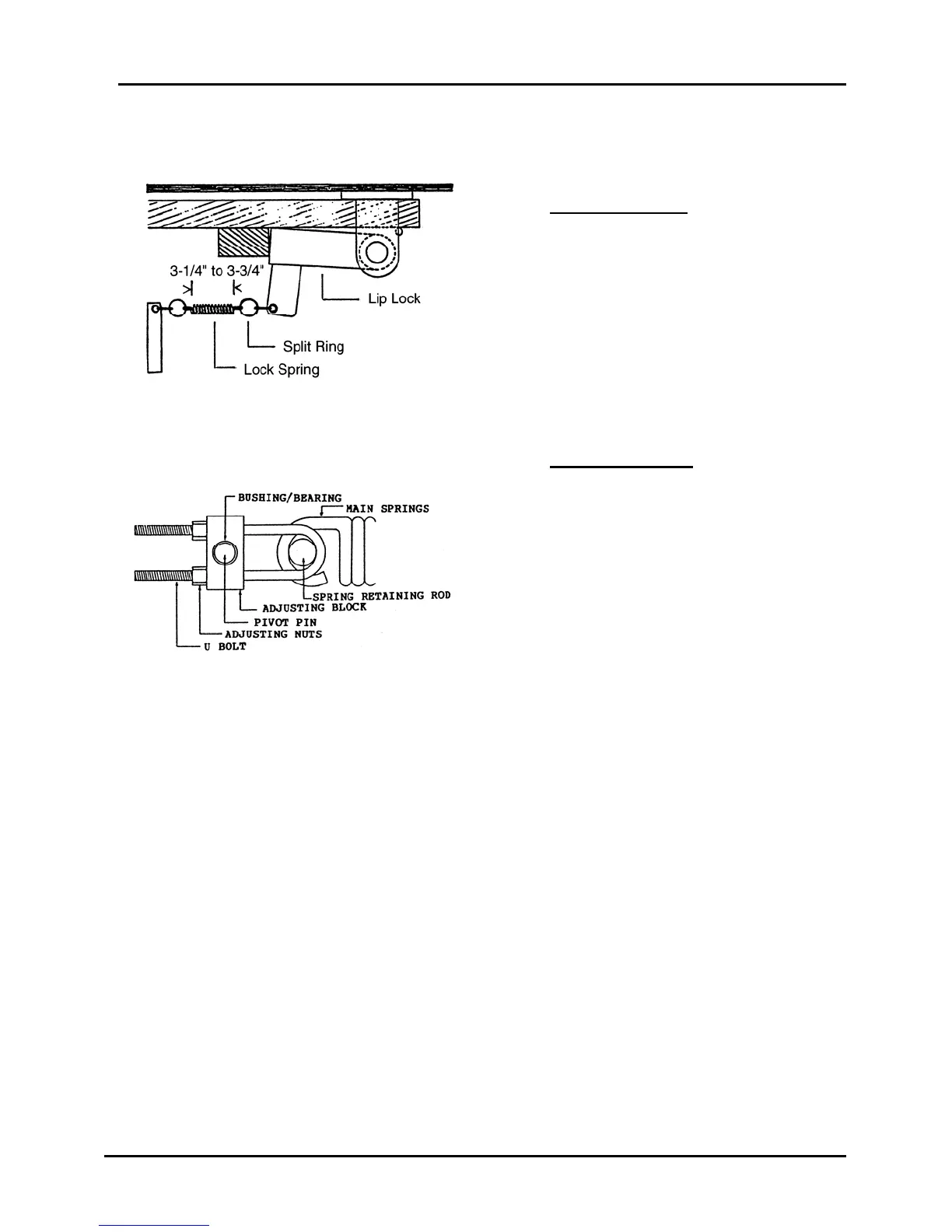
Step Number 4: Observe the lip-
lock spring assembly, Figure 4 and
item ‘D’, Figure 2. The spring body
should measure 3-1/4” to 3-3/4”
long. If spring body is too short,
remove and discard one split ring
from the spring assembly.
Reassemble and test.
Step Number 5: Main lift spring
adjustment. Before adjusting,
assure adjustment Steps 1 through
4 have been performed. Increase
spring tension if lip does not lock.
Decrease spring tension if deck is
“too hard to walk down”.
Turn “U” bolt adjusting nuts, figure
5, clockwise to increase, and
counterclockwise to decrease
spring tension. Always use equal
turns on each of the adjusting nuts.
Tension must be adequate to swing
the lip up to its fully raised position
to allow the lip lock to be pulled into
locked position as the deck stops at
its fully raised position. Excess
tension will cause the deck to be
unacceptably hard to lower. Do not
over tension springs.
Figure 4
Figure 5
The spring tension is correct when an average weight person, standing on the lip hinge area
of the fully raised, lip extended deck, must perform a “pushing action” with the legs and feet.
Lower the body by bending the knees slightly, and then straighten the legs quickly to return
the body to the full standing position. This pushing action will transfer additional weight to
the deck, causing it to lower to dock height or below. A lighter than average person may
have to perform this pushing action more than once to start the deck moving downward, and
a heavier than average person may cause the deck to lower as he / she reaches the lip
hinge area, after walking up the deck.



 To Next Page