Mechanical Dock Leveler – M and FMC Group 08, Section 15, Page 1
Issue Date: 10/01/01, Rev. 0 (Part #038-550E)
LIP CROWN MODIFICATION – Special Application
Increasing Lip Crown
NOTE: The following instructions and
information are to be used only after a
thorough inspection has been
performed to verify that damage or
excessive wear are not evident in any
of the associated components.
Do not change the lip crown to
compensate for damage or wear.
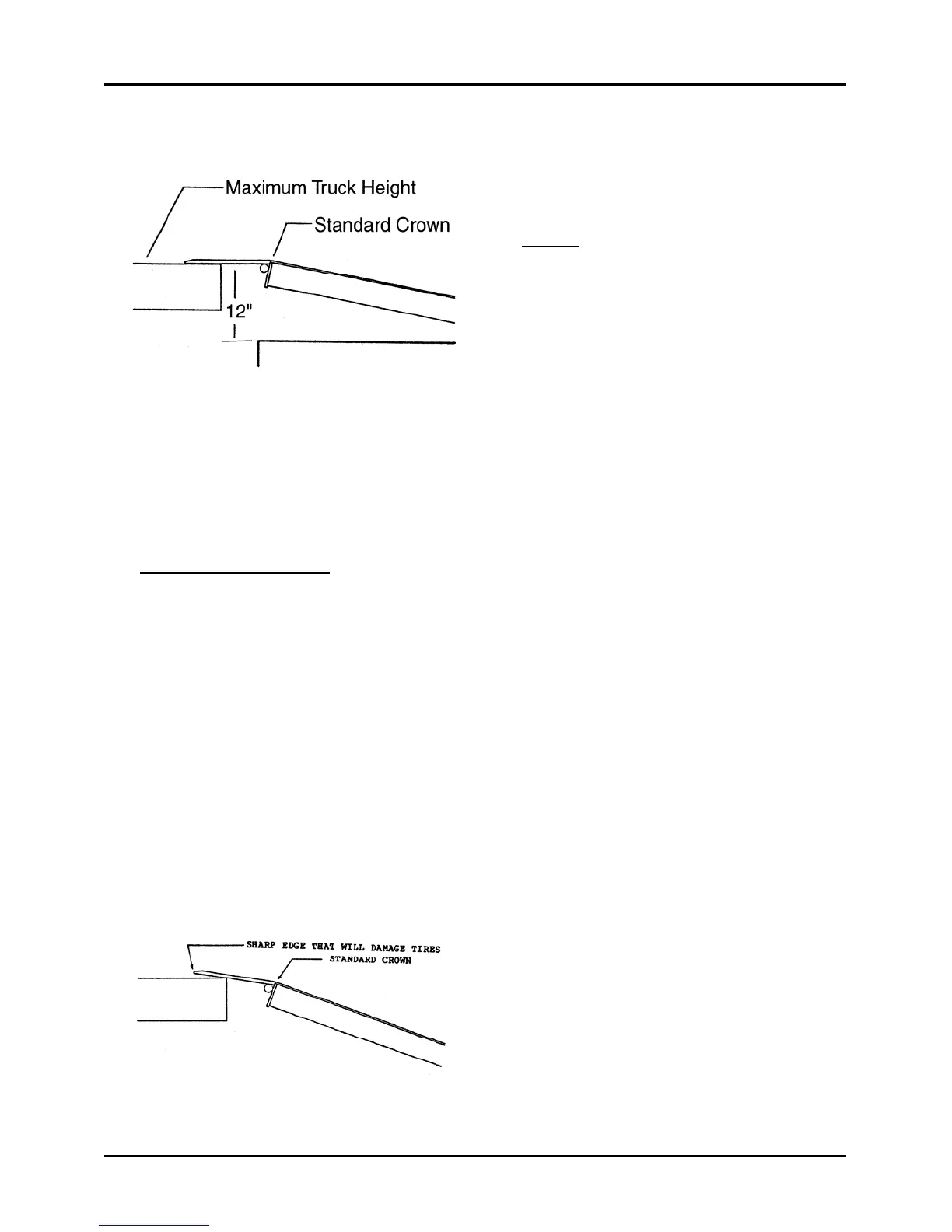
Figure 89
Changing the lip crown will affect the operating range and efficiency of the dock
lever. Investigate the application thoroughly when considering a crown change, to
assure the change will not adversely affect the overall efficiency of the specific
application.
Increasing Lip Crown: This modification is unusual and is most often considered
as a possible solution for the problems experienced when higher than normal
vehicles such as shipping containers must be serviced with a dock leveler that is not
of sufficient overall length. Eg: A dock leveler that is 144" overall length is
recommended for use when the height differential between truck bed and dock is 12"
and a low lift pallet truck will be used for unloading/loading. Increasing the amount
of lip crown will allow the tip of the lip to maintain contact with the high vehicle, but it
may also create a hang-up point for limited under clearance material handling
equipment such as pallet trucks. The degree of incline of the dock leveler deck will
also increase slightly, requiring more overhead clearance for high loads and lift truck
masts. Replacing the complete dock leveler is often the only satisfactory method of
solving this problem.
Figure 89, illustrates a standard crown dock leveler positioned on a truck bed that is
at maximum height for the dock leveler length.
Figure 90, illustrates the same
standard crown dock leveler as shown
in Figure 89, positioned on a truck bed
that is higher than recommended for
the dock leveler length. Note that the
tip of the lip is not in contact with the
truck bed, creating a sharp edge that
will damage the tires etc. of the
material handling truck exiting the
vehicle.
Figure 90



 To Next Page