EasyManua.ls Logo

Commodore 128D - Page 197

Commodore 128D
427 pages
Print Icon
To Next Page IconTo Next Page
To Previous Page IconTo Previous Page
Loading...
n
For
transient
utilities,
CP/M
3.0
checks
only
the
command
keyword.
Many
utilities
require
unique
command
tails.
If
you
include
a
com
mand
tail,
CP/M
3.0
passes
it
to
the
utility
without
checking
it.
A
command
tail
cannot
contain
more
than
128
characters.
How
CP/M
Reads
Command
Lines
Let's
use
the
DIR
command
to
demonstrate
how
CP/M
reads
com
mand
lines.
DIR,
which
is
an
abbreviation
for
directory,
tells
CP/M
to
display
a
directory
of
disk
files
on
your
screen.
Type
the
DIR
keyword
after
the
system
prompt,
and
press
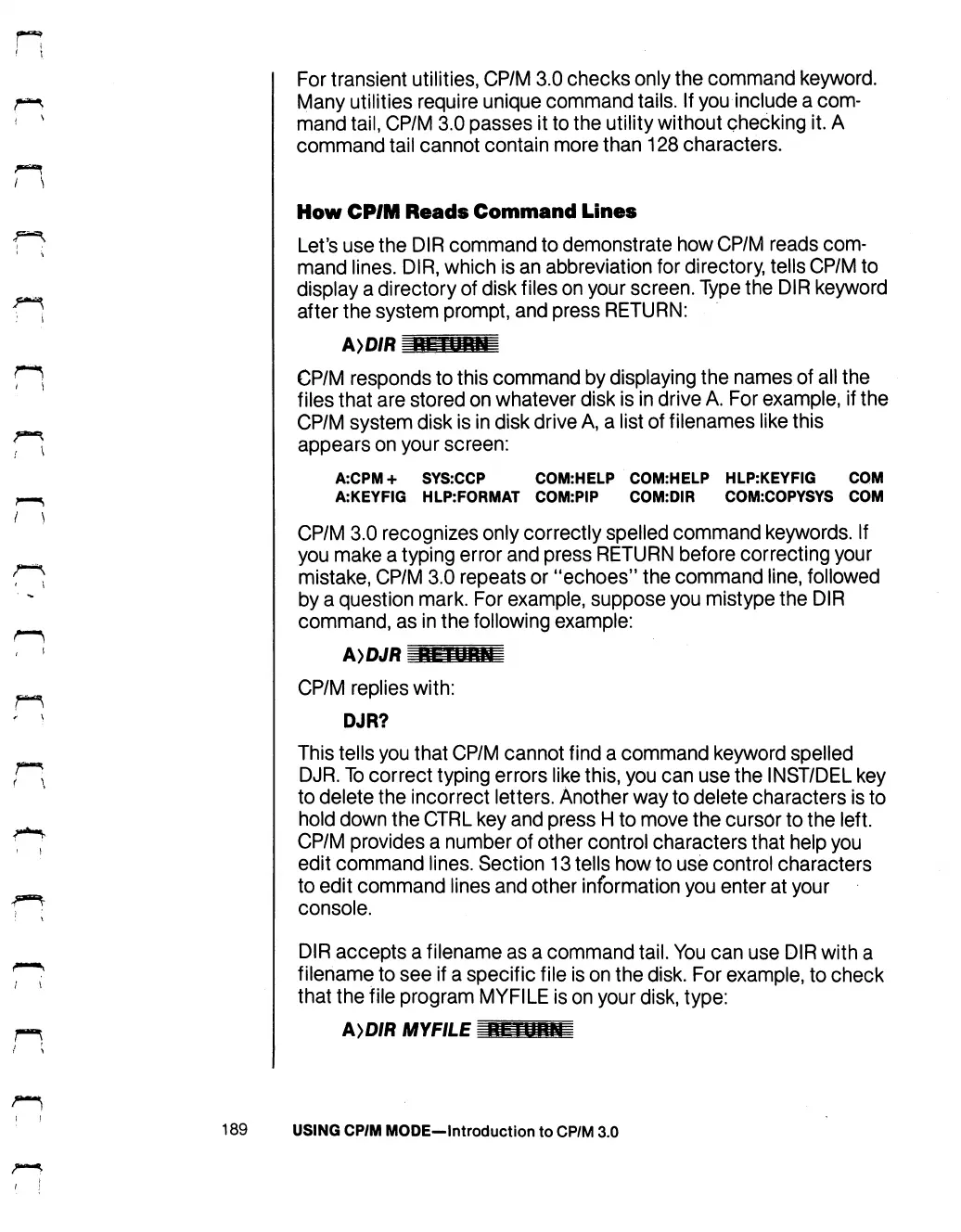
RETURN:
CP/M
responds
to
this
command
by
displaying
the
names
of
all
the
files
that
are
stored
on
whatever
disk
is
in
drive
A.
For
example,
if
the
CP/M
system
disk
is
in
disk
drive
A,
a
list
of
filenames
like
this
appears
on
your
screen:
A:CPM+
SYS:CCP
COM:HELP
COM:HELP
HLP:KEYFIG
COM
A:KEYFIG
HLP:FORMAT
COM:PIP
COM:DIR
COM:COPYSYS
COM
CP/M
3.0
recognizes
only
correctly
spelled
command
keywords.
If
you
make
a
typing
error
and
press
RETURN
before
correcting
your
mistake,
CP/M
3.0
repeats
or
"echoes"
the
command
line,
followed
by a
question
mark.
For
example,
suppose
you
mistype
the
DIR
command,
as
in
the
following
example:
A>DJR
CP/M
replies
with:
DJR?
This
tells
you
that
CP/M
cannot
find
a
command
keyword
spelled
DJR.
To
correct
typing
errors
like
this,
you
can
use
the
INST/DEL
key
to
delete
the
incorrect
letters.
Another
way
to
delete
characters
is
to
hold
down
the
CTRL
key
and
press
H
to
move
the
cursor
to
the
left.
CP/M
provides
a
number
of
other
control
characters
that
help
you
edit
command
lines.
Section
13
tells
how
to
use
control
characters
to
edit
command
lines
and
other
information
you
enter
at
your
console.
DIR
accepts
a
filename
as
a
command
tail.
You
can
use
DIR
with
a
filename
to
see
if
a
specific
file
is
on
the
disk.
For
example,
to
check
that
the
file
program
MYFILE
is
on
your
disk,
type:
A>D/R
MYFILE
\
189
USING
CP/M
MODE—Introduction
to
CP/M
3.0

Table of Contents

Other manuals for Commodore 128D

Related product manuals