EasyManua.ls Logo

Commodore 128D - Page 196

Commodore 128D
427 pages
Print Icon
To Next Page IconTo Next Page
To Previous Page IconTo Previous Page
Loading...
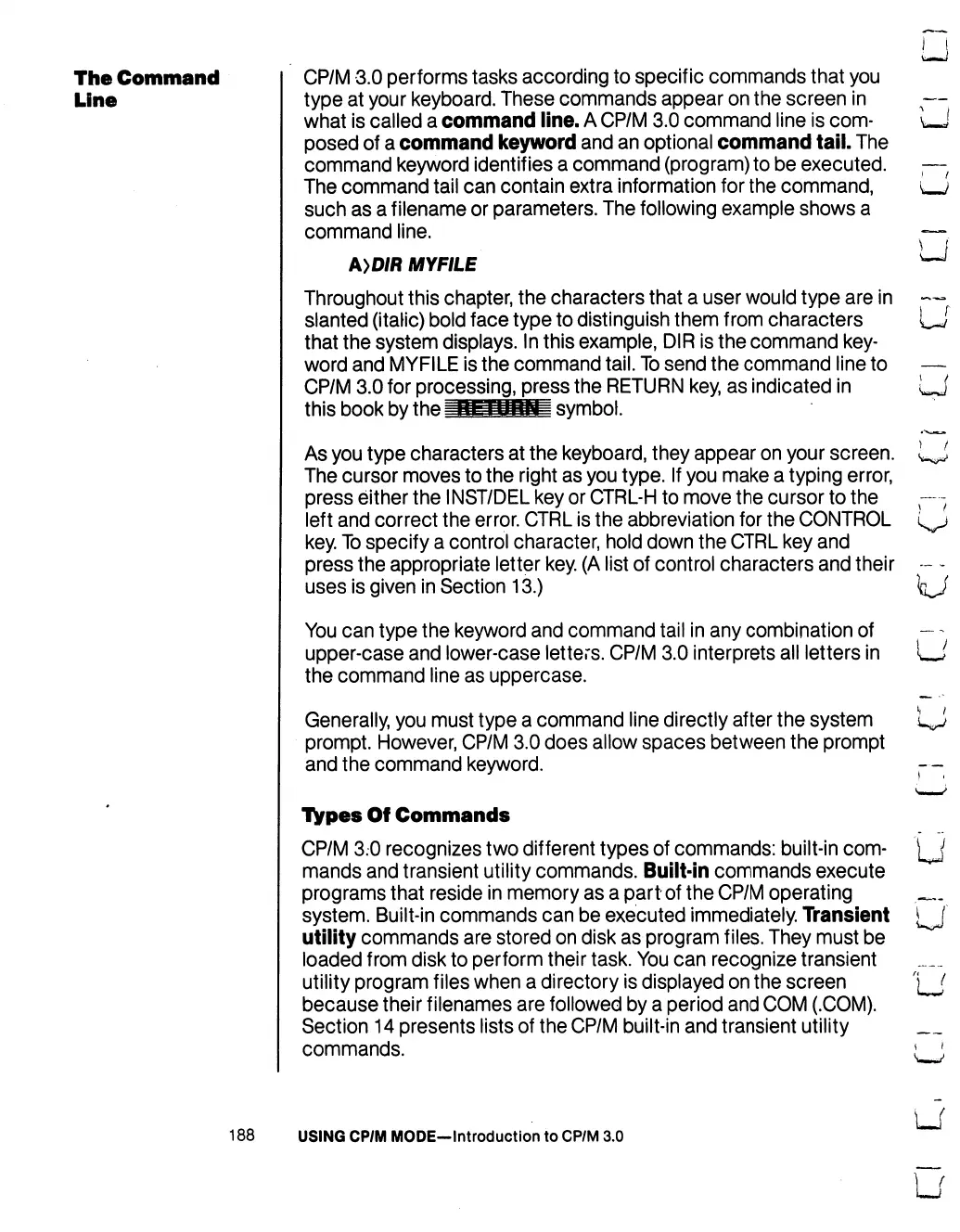
The
Command
Line
CP/M
3.0
performs
tasks
according
to
specific
commands
that
you
type
at
your
keyboard.
These
commands
appear
on
the
screen
in
what
is
called
a
command
line.
A
CP/M
3.0
command
line
is
com
posed
of
a
command
keyword
and
an
optional
command
tail.
The
command
keyword
identifies
a
command
(program)
to
be
executed.
The
command
tail
can
contain
extra
information
for
the
command,
such
as
a
filename
or
parameters.
The
following
example
shows
a
command
line.
A>DIRMYFILE
Throughout
this
chapter,
the
characters
that
a
user
would
type
are
in
slanted
(italic)
bold
face
type
to
distinguish
them
from
characters
that
the
system
displays.
In
this
example,
DIR
is
the
command
key
word
and
MYFILE
is
the
command
tail.
To
send
the
command
line
to
CP/M
3.0
for
processing,
press
the
RETURN
key,
as
indicated
in
this
book
by
the
HMUHNi
symbol.
As
you
type
characters
at
the
keyboard,
they
appear
on
your
screen.
The
cursor
moves
to
the
right
as
you
type.
If
you
make
a
typing
error,
press
either
the
INST/DEL
key
or
CTRL-H
to
move
the
cursor
to
the
left
and
correct
the
error.
CTRL
is
the
abbreviation
for
the
CONTROL
key.
To
specify
a
control
character,
hold
down
the
CTRL
key
and
press
the
appropriate
letter
key.
(A
list
of
control
characters
and
their
uses
is
given
in
Section
13.)
You
can
type
the
keyword
and
command
tail
in
any
combination
of
upper-case
and
lower-case
letters.
CP/M
3.0
interprets
all
letters
in
the
command
line
as
uppercase.
Generally,
you
must
type
a
command
line
directly
after
the
system
prompt.
However,
CP/M
3.0
does
allow
spaces
between
the
prompt
and
the
command
keyword.
Types
Of
Commands
CP/M
3.0
recognizes
two
different
types
of
commands:
built-in
com
mands
and
transient
utility
commands.
Built-in
commands
execute
programs
that
reside
in
memory
as
a
part
of
the
CP/M
operating
system.
Built-in
commands
can
be
executed
immediately.
Transient
utility
commands
are
stored
on
disk
as
program
files.
They
must
be
loaded
from
disk
to
perform
their
task.
You
can
recognize
transient
utility
program
files
when
a
directory
is
displayed
on
the
screen
because
their
filenames
are
followed
by
a
period
and
COM
(.COM).
Section
14
presents
lists
of
the
CP/M
built-in
and
transient
utility
commands.
188
USING
CP/M
MODE—Introduction
to
CP/M
3.0
Li
o

Table of Contents

Other manuals for Commodore 128D

Related product manuals