EasyManua.ls Logo

Commodore 128D - Page 344

Commodore 128D
427 pages
Print Icon
To Next Page IconTo Next Page
To Previous Page IconTo Previous Page
Loading...
u
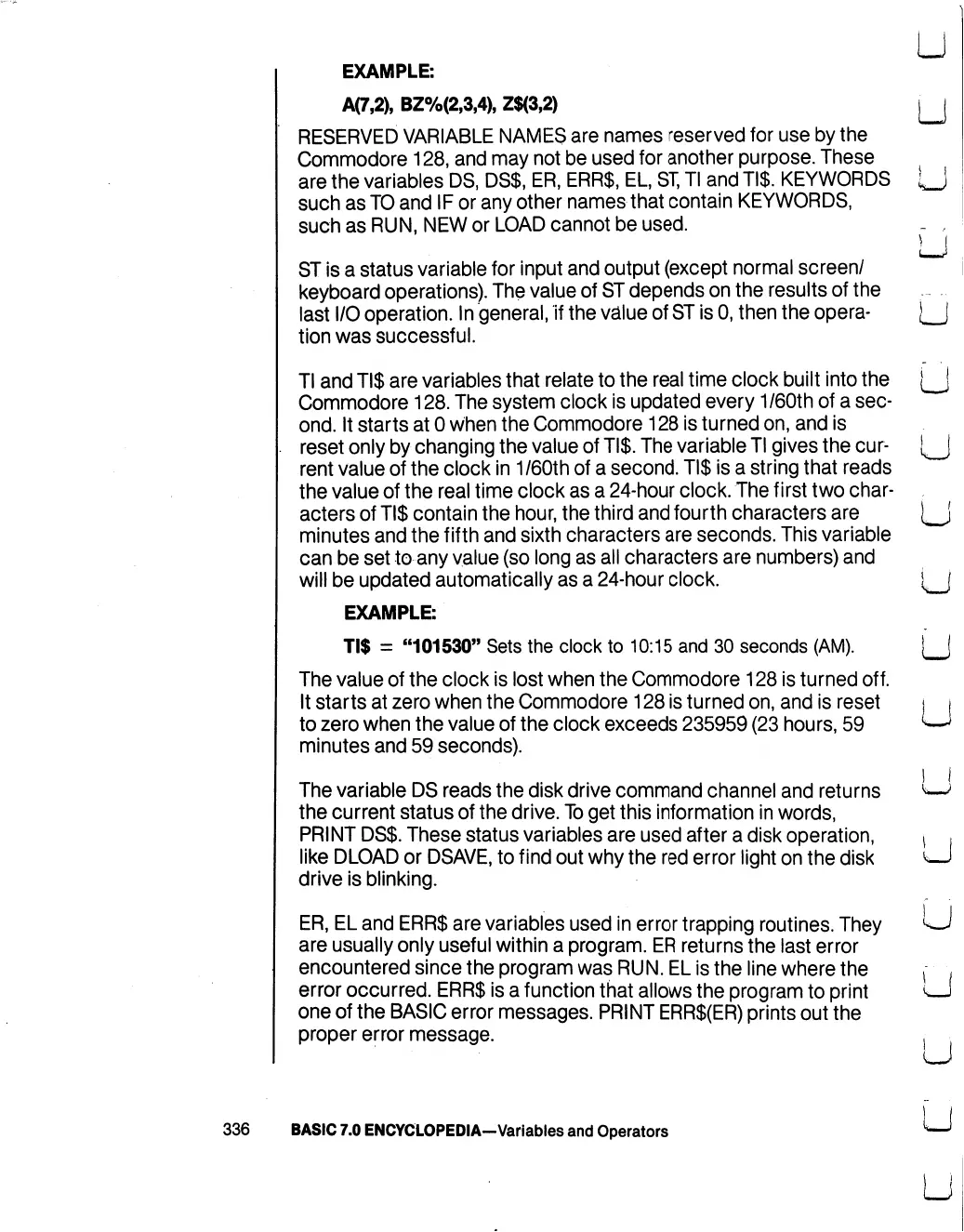
EXAMPLE:
A(7,2),
BZ%(2,3,4),
Z$(3,2)
jj
RESERVED
VARIABLE
NAMES
are
names
reserved
for
use
by
the
Commodore
128,
and
may
not
be
used
for
another
purpose.
These
are
the
variables
DS,
DS$,
ER,
ERR$,
EL,
ST, Tl
and
Tl$.
KEYWORDS
U
such
as
TO
and
IF
or
any
other
names
that
contain
KEYWORDS,
such
as
RUN,
NEW
or
LOAD
cannot
be
used.
-
,
LJ
ST
is
a
status
variable
for
input
and
output
(except
normal
screen/
keyboard
operations).
The
value
of
ST
depends
on
the
results
of
the
last
I/O
operation.
In
general,
if
the
value
of
ST
is
0,
then
the
opera-
}
j
tion
was
successful.
Tl
and
Tl$
are
variables
that
relate
to
the
real
time
clock
built
into
the
| j
Commodore
128.
The
system
clock
is
updated
every
1/60th
of
a
sec
ond.
It
starts
at
0
when
the
Commodore
128
is
turned
on,
and
is
reset
only
by
changing
the value
of
Tl$.
The
variable
Tl
gives
the
cur
rent
value
of
the
clock
in
1/60th
of
a
second.
Tl$
is
a
string
that
reads
the
value
of
the
real
time
clock
as
a
24-hour
clock.
The
first
two
char
acters
of
Tl$
contain
the
hour,
the
third
and
fourth
characters
are
minutes
and
the
fifth
and
sixth
characters
are
seconds.
This
variable
can
be
set
to
any
value
(so
long
as
all
characters
are
numbers)
and
will
be
updated
automatically
as
a
24-hour
clock.
EXAMPLE:
Tl$
=
"101530"
Sets
the
clock
to
10:15
and
30
seconds
(AM).
The
value
of
the
clock
is
lost
when
the
Commodore
128
is
turned
off.
It
starts
at
zero
when
the
Commodore
128
is
turned
on,
and
is
reset
to
zero
when
the
value
of
the
clock
exceeds
235959
(23
hours,
59
minutes
and
59
seconds).
The
variable
DS
reads
the
disk
drive
command
channel
and
returns
the
current
status
of
the
drive.
To
get
this
information
in
words,
PRINT
DS$.
These
status
variables
are
used
after
a
disk
operation,
like
DLOAD
or
DSAVE,
to
find
out
why
the
red
error
light
on
the
disk
drive
is
blinking.
ER,
EL
and
ERR$
are
variables
used
in
error
trapping
routines.
They
are
usually
only
useful within
a
program.
ER
returns
the
last
error
encountered
since
the
program
was
RUN.
EL
is
the
line
where
the
error
occurred.
ERR$
is
a
function
that
allows
the
program
to
print
one
of
the
BASIC
error
messages.
PRINT
ERR$(ER)
prints
out
the
proper
error
message.
336
BASIC
7.0
ENCYCLOPEDIA-Variables
and
Operators

Table of Contents

Other manuals for Commodore 128D

Related product manuals