EasyManua.ls Logo

Commodore 128D - Page 345

Commodore 128D
427 pages
Print Icon
To Next Page IconTo Next Page
To Previous Page IconTo Previous Page
Loading...
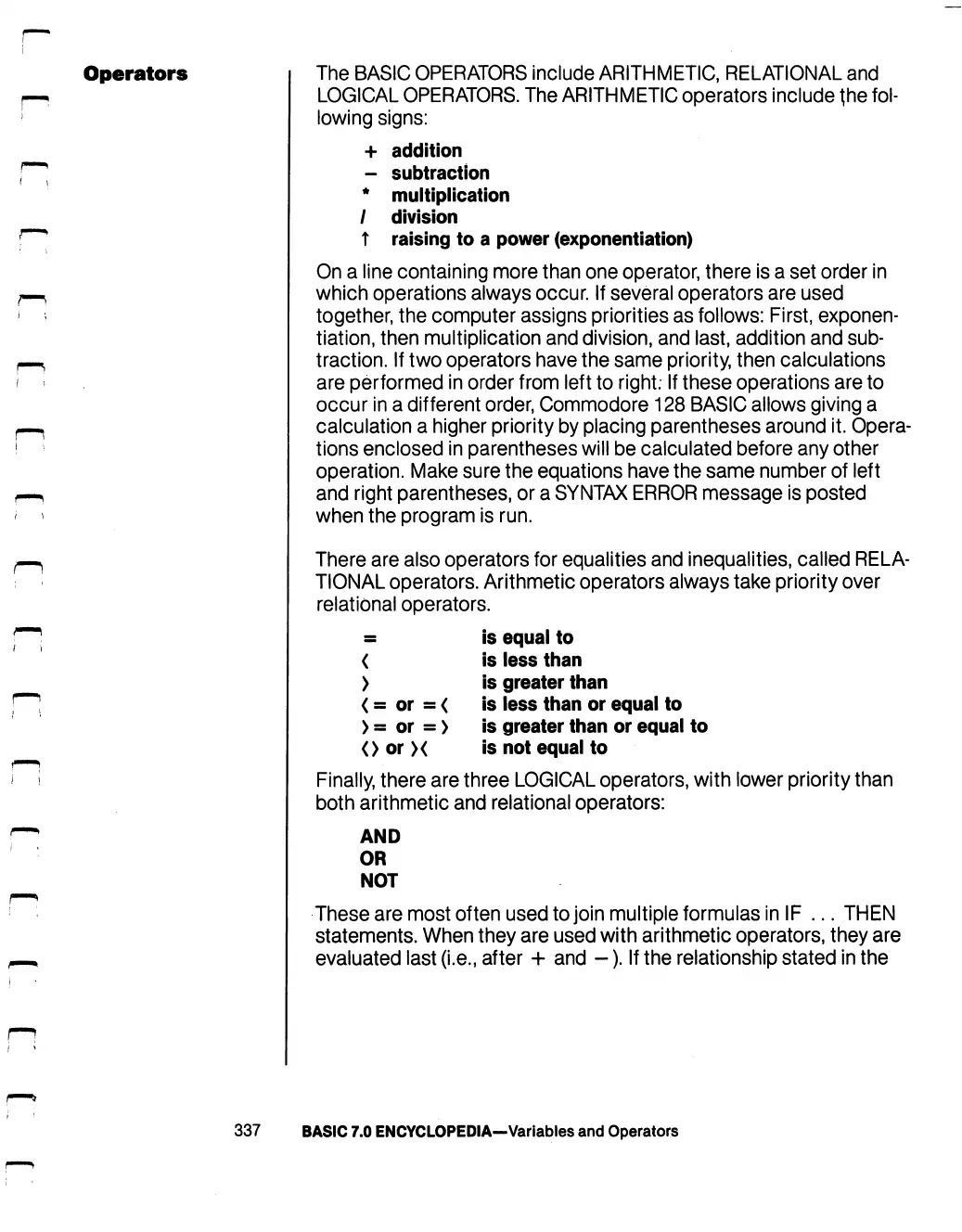
Operators
(
i
i
l
i
The
BASIC
OPERATORS
include
ARITHMETIC,
RELATIONAL
and
LOGICAL
OPERATORS.
The
ARITHMETIC
operators
include
the
fol
lowing
signs:
+
addition
-
subtraction
*
multiplication
/
division
t
raising
to
a
power
(exponentiation)
On
a
line
containing
more
than
one
operator,
there
is
a
set
order
in
which
operations
always
occur.
If
several
operators
are
used
together,
the
computer
assigns
priorities
as
follows:
First,
exponen
tiation,
then
multiplication
and
division,
and
last,
addition
and
sub
traction.
If
two
operators
have
the
same
priority,
then
calculations
are
performed
in
order
from
left
to
right;
If
these
operations
are
to
occur
in
a
different
order,
Commodore
128
BASIC
allows
giving
a
calculation
a
higher
priority
by
placing
parentheses
around
it.
Opera
tions
enclosed
in
parentheses
will
be
calculated
before
any
other
operation.
Make
sure
the
equations
have
the
same
number
of
left
and
right
parentheses,
or
a
SYNTAX
ERROR
message
is
posted
when
the
program
is
run.
There
are
also
operators
for
equalities
and
inequalities,
called
RELA
TIONAL
operators.
Arithmetic
operators
always
take
priority
over
relational
operators.
=
is
equal
to
<
is
less
than
>
is
greater
than
<
=
or
=
<
is
less
than
or
equal
to
>
=
or
=
>
is
greater
than
or
equal
to
<>
or
><
is
not
equal
to
Finally,
there
are
three
LOGICAL
operators,
with
lower
priority
than
both
arithmetic
and
relational
operators:
AND
OR
NOT
These
are
most
often
used
to
join
multiple
formulas
in
IF
...
THEN
statements.
When
they
are
used
with
arithmetic operators,
they
are
evaluated
last
(i.e.,
after
+
and
-).
If
the
relationship
stated
in
the
337
BASIC
7.0
ENCYCLOPEDIA—Variables
and
Operators

Table of Contents

Other manuals for Commodore 128D

Related product manuals