A(3,4) = 255
i L COLUMN
ROW
~
1
2
3
4
255
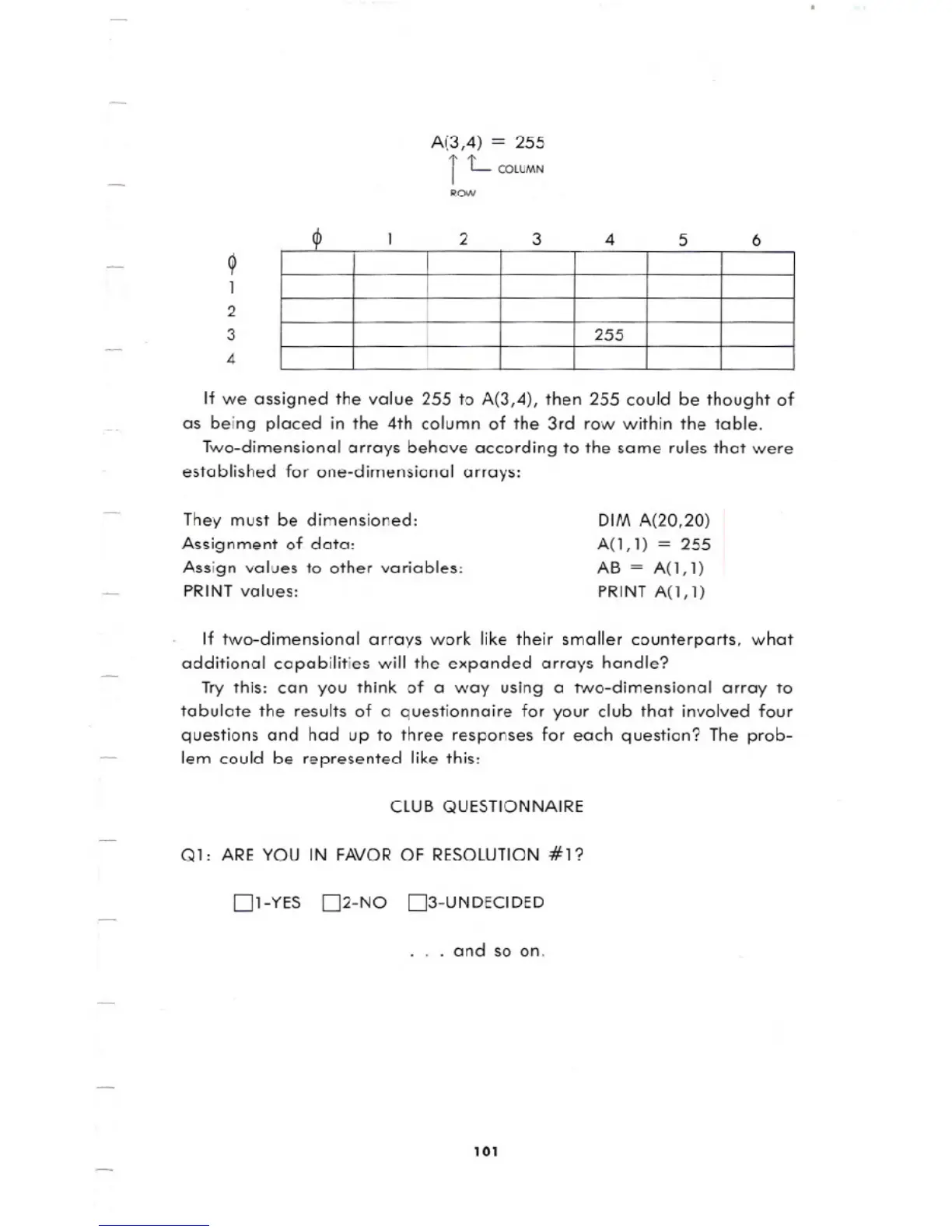
If we assigned the value 255 to A(3,4), then 255 could be thought of
as
being placed in the 4th column of the 3rd row within the table.
Two-dimensional arrays behave according to the same rules that were
established for one-dimensional arrays:
They must be dimensioned:
Assignment of data:
Assign values to other variables:
PRINT
values:
DIM A(20,20)
A( I, 1) = 255
AB = A(l,1)
PRINT A(I, 1)
If two-dimensional arrays work like their smaller counterparts, what
additional capabilities will the expanded arrays handle?
Try this: can you think of a way using a two-dimensional array to
tabulate the results of a questionnaire for your club that involved four
questions and had up to three responses for each question? The prob-
lem could be represented like this:
CLUB QUESTIONNAIRE
Ql: ARE YOU IN FAVOR OF RESOLUTION #1?
01-YES 02-NO 03-UNDECIDED
. . . and so on.
101





 To Next Page