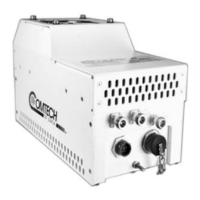
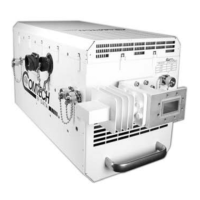
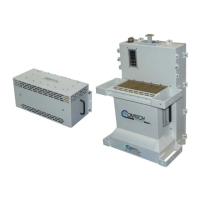
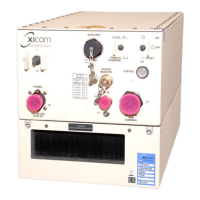
LPOD C- / Ku-Band Outdoor Amplifier/ Block Up Converter (BUC) Revision 3
Appendix B MN-LPOD
B–2
B.1.4 Faults
The M&C system monitors certain key functions of the LPOD for proper operation. Should any
of these parameters exceed predetermined limits, the M&C system will declare a fault. The
conditions that trigger a fault are:
• Any power supply more than ± 10% outside its nominal value.
• Fan less than 25% of maximum speed.
• I2C internal bus communications fault.
• Thermal Shutdown – A temperature fault is indicated if the unit is +>90°C. This creates
a summary fault and will cause the unit to mute itself and switch to the back-up unit (if in
a redundant system). However, the 10V supply to the FET transistors will remain on until
the unit reaches the thermal shutdown temperature of ≥ >95°C. For protection reasons,
the unit will shut down the 10V supply to the power transistors at temperatures >95°C.
• Firmware checksum error at power up.
• FPGA done indicator error at power up.
• *Block upconverter (BUC) unlocked.
• Redundant waveguide switch position fault (applies to redundant mode operation only).
• Redundant inter-unit link fault (applies to redundant mode operation only).
• Low noise block converter (LNB) current over limit.
The following parameters can be user defined to report an alarm condition, a fault condition, or
the parameter can be ignored completely by masking it:
• RF amplifier low output power (user adjustable value)
• Internal reference oscillator unlocked
• *LNB converter current outside specified window
• *LNB voltage out of tolerance
*NOTE: If this parameter generates a fault condition, the RF output will be muted.
B.1.5 Power Detector
A power detector is provided to monitor the output power. It has a useful range of over 20 dB,
referenced to the unit’s rated P1dB point, and its value can be read by exercising the
RMS
command. The test data supplied with each unit gives an indication of the excellent accuracy and
flatness of the power monitor over the frequency band of operation.
B.1.6 Some Common Commands
A few of the most common commands and queries are listed below. Full details for each of these
are listed at the end of this section.
•
RMS: Retrieve Maintenance Status. Displays voltages, fan speeds, Heatsink temperature,
output power monitor reading, etc.
•
RCS: Retrieve Configuration Status. Displays current attenuation, mute, amplifier,
online, etc. status.
•
RAS: Retrieve Alarm Status. Displays current alarm or fault status.


 To Next Page