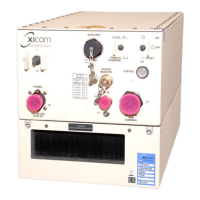
LPOD C-/Ku-Band Outdoor Amplifier / Block Up Converter (BUC) Revision 3
Flash Upgrading MN-LPOD
3–3
The downloadable files are stored in two archived formats: *.exe (self-extracting) and *.zip
(compressed). Some firewalls will not allow download of *.exe files. In this case, download the
*.zip file instead.
For additional help with "zipped" file types, refer to the Help file for your particular product;
online references are also available:
• For PKZIP for Windows:
http://www.pkware.com/home_and_small_office/support/manuals/windows.php
IMPORTAN
PKZIP for DOS is not supported due to file naming conventions.
•
For WinZip: http://www.winzip.com/winzip.htm
For ZipCentral: http://hemsidor.torget.se/users/z/zcentral/faq.html
4
Extract the files into the temporary folder on the PC. At least two files should be extracted:
• The bulk image file, FWxxxxxxx.bin, where "x" is thefirmware number and
revision;
• The release notes.
5
Confirm that the files have been extracted to the specified temporary folder on the PC. In DOS,
use “cd c:\temp” to change to the temporary directory created in Step 2, then use the “dir”
command to list the files extracted from the downloaded archive file.
6
Download and unzip the CReflash.zip file to the temporary folder using the same procedures
as previously described in Steps 3 through 5.
7
Install the CReflash application by double clicking on the setup.exe file. The default
parameters for all boxes are generally acceptable.
8
Connect the PC to the LPOD’s J6 / COM1 port using the appropriate adapter cable.
9
Send a “ping” command to the LPOD to verify the connection and communication.
The IP address of the LPOD can be found remotely using the <0/IPA? query.
Then, using DOS to PING: Click [Start] on the Windows toolbar, then click the [Run...]
option. As an alternative, use the “DOS Prompt” or “Command Prompt” icons in the [Start]
Menu:
• Using Win95 or Win98: Type “command”.
• Using WinNT, Win2K or WinXP: Type “cmd”.
At the DOS prompt, type “ping xxx.xxx.xxx.xxx” (where "xxx.xxx.xxx.xxx" is the LPOD IP
address). The results should confirm whether or not the unit is connected and communicating.


 To Next Page