39
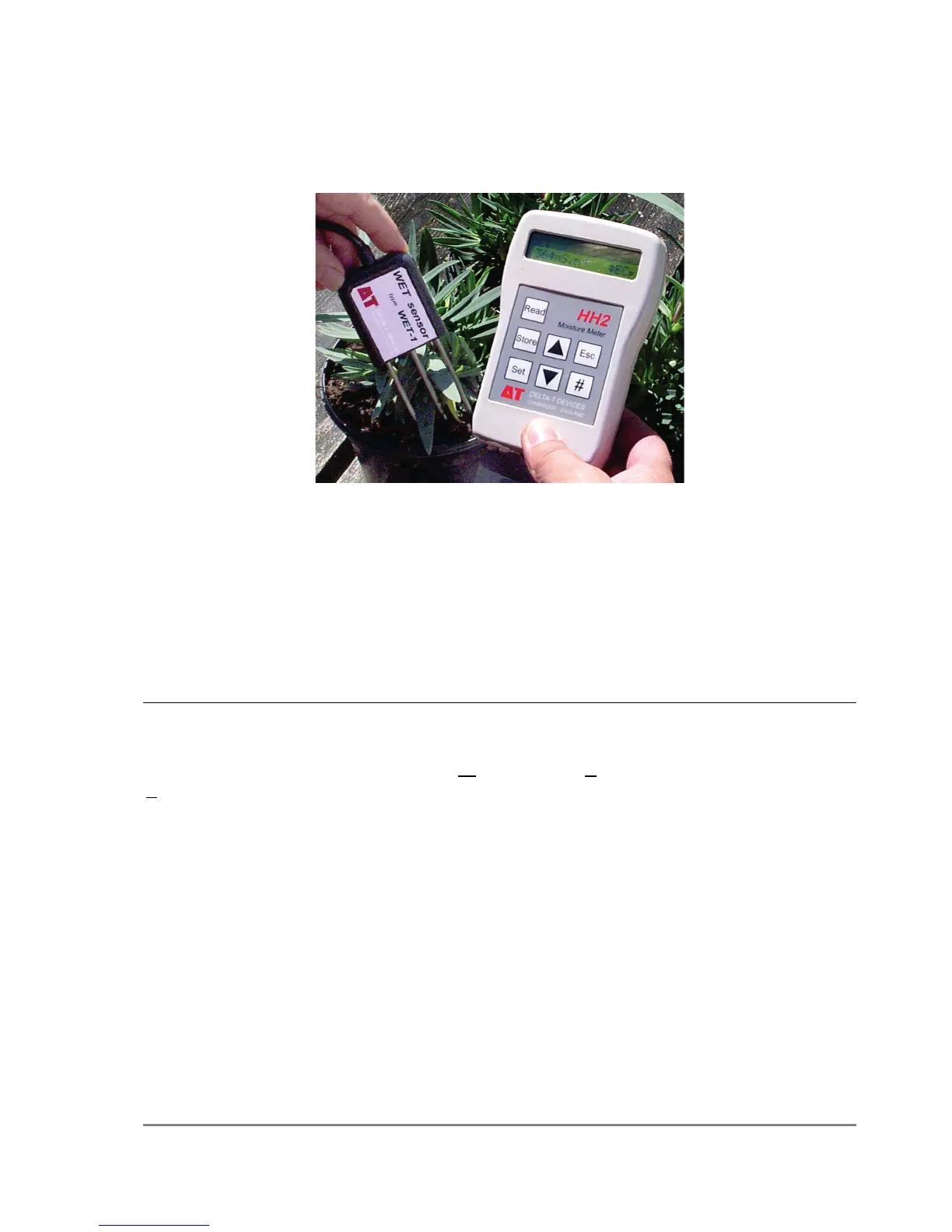
WET Sensor
Contents:
About WET Sensors
Menu Navigation Map
Options
WET Options Summary
Reading the WET Sensor
About WET Sensors
The WET sensor's name comes from Water content, Electrical conductivity and
Temperature.
WET sensors directly measure soil permittivityε, bulk electrical conductivity (denoted
σ
b
or EC
b
) and Temperature. From these, and with the use of specific soil calibration
tables and equations, the HH2 calculates volumetric soil moisture θ, and pore water
conductivity σ
p
or EC
p.
The WET sensor is used in precision horticulture and soil science research and is
usable in both soils and a variety of artificial growing substrates, such as rock wool. It
is unique in its ability to measure pore water conductivity - which is the conductivity
directly available to the plant (indicating, for instance, the availability of nutrients in
solution).
See also the WET user manual.
The standard HH2 include WET sensor soil parameters for organic, mineral, clay and
sand. Additional artificial soil substrates such as coir, stonewool & peat may be
installed in the HH2, but this has to be done at Delta-T.


 To Next Page