AIR_Manual_506a_ENG_rev_1.pdf Page 27/96
11-SENSORS VARIOMETER WITH SELF - ADAPTIVE SENSITIVITY
It's a revolutionary digital system designed by Digifly, based on a sophisticated data acquisition system updated
100 times each second that merges 11 sensors: the atmospheric pressure sensor data with the Pitot tube
sensor and the 9 sensors of the inertial data platform (3 accelerometers, 3 magnetometers and 3 gyroscopes).
It is also equipped with
self-adaptive sensitivity
that auto-modulates the instruments sensitivity according to the
air’s conditions: it increases it in weak conditions and decreases in strong conditions or turbulence.
This allows to have a vario with high sensitivity and instantaneous response, that is yet fluid and immune
to the turbulence while very helpful in weak conditions, thanks to its pre-thermal function. Furthermore,
in contrast to varios, based on a pressure sensor only, the Digifly is not affected by false readings due to
acceleration.
: The mathematical method that manages the variometer has been optimized to obtain
an excellent response during flights; for this reason, we suggest you try or compare it flying and not on
the ground.
Even though the system is totally automated it is possible to manually force the values of some filters:
Parameter
VARIOMETER SETUP \ n. 10 RVAR
, ranges from 1 (minimum reactivity) to 20 (maximum reactivity);
default 10.
Shows instant climbing or descending values in a range of +/- 25 m/s in digital format +/- 5,000 fpm.
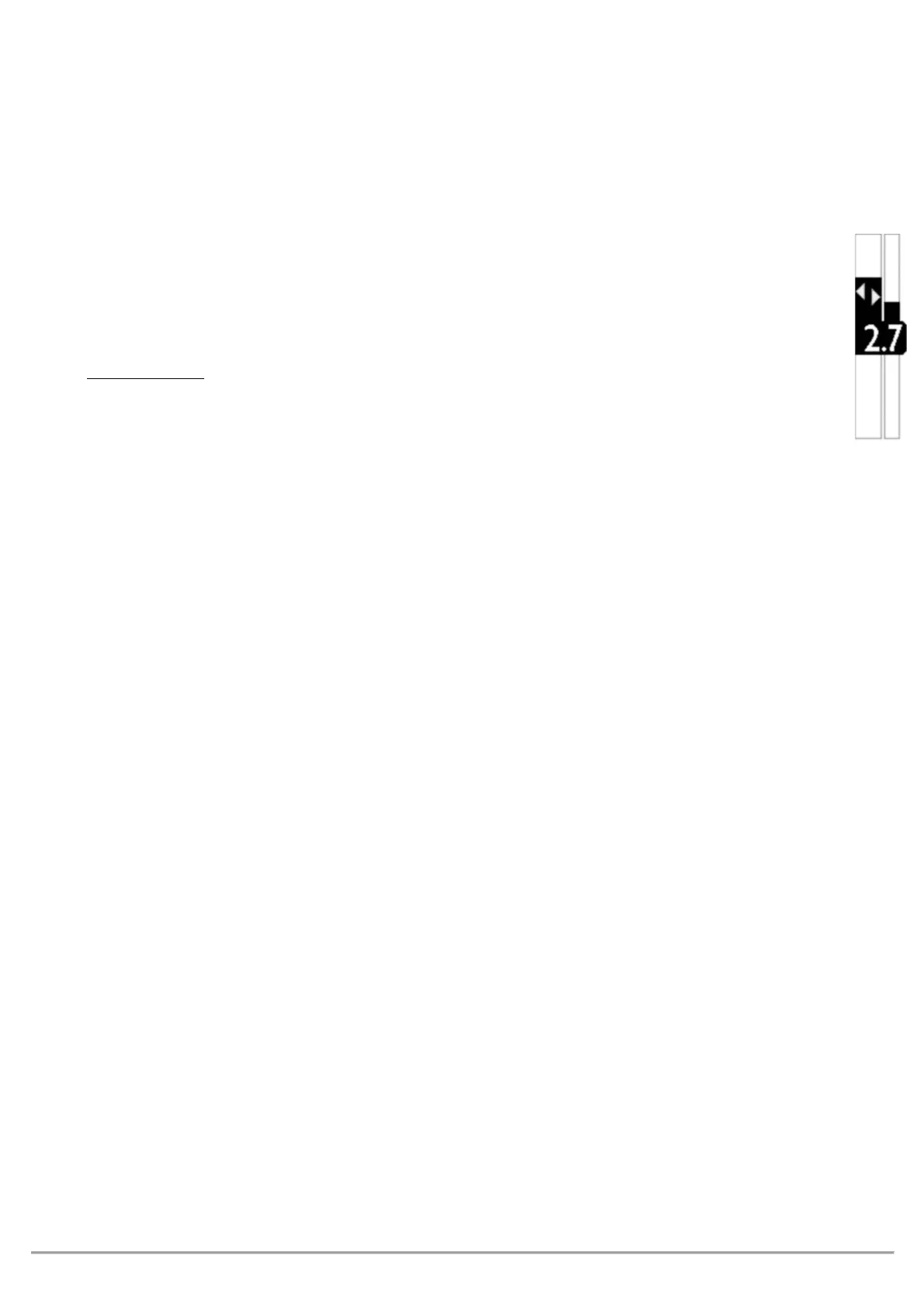
Indicates the instant vario values; it is displayed by the analogical bar indicator on the left of the screen that
shows the sink or climb rate within a +/- 5 m/s range, +/- 500 fpm range.
INTEGRATED (AVERAGE) VARIO
The right-hand bar shows the integrated vario values; the average of the instant vario during X amount of time
(this bar can be changed to the value of the net vario, see section 4.2.6).
It can be used to monitor the progression of your climb to see if it is getting better or worse. For example, if the
integrated vario value is higher than the instant vario, it means that the climb was previously stronger; it can be
used, therefore, to better core the thermal.
The averaging time (integration time) can be set with
VARIOMETER SETUP \ n. 11 INTE
, ranging from 5 to 60
seconds.
NET VARIO (WITH OPTIONAL PITOT TUBE)
The bar on the right hand, analogically indicates the climb/descent rate values of the air mass around you in a
+/- 5m/s (approx. 1,000fpm) range. It can also be set to display the average vario values instead (see 4.2.6).
When the netto vario is being displayed, the icon “NET” will show on the right-hand bar.
In order to use this function, you must have a Digifly AIR with Pitot Tube option and that the tube is
installed on the instrument; also, you need to have the Polar coefficients to be programmed in your instrument
(for example, you have Polar 1:
ADVANCED SETUP \ n. 11-12-13 P1A-P1B-P1C
)
and set the Polar parameter to
use the values stored for Polar 1 (for example, Polar 1:
ADVANCED SETUP \ n. 10 POLA=1
).


 To Next Page