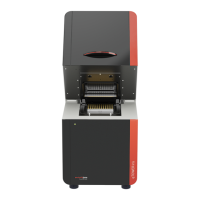
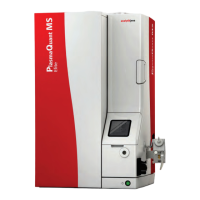
PlasmaQuant 9100 (Elite) Function and design
13
3 Function and design
3.1 Function and measuring principle
ICP emission spectrometry (ICP-OES) uses of plasma at temperatures of up to 10000 K.
This high temperature is focused in a very small area of approx. 5 cm³
. The sample is in-
troduced to this plasma in aerosol form (small droplets in a gas). The droplets dry, melt,
vaporize and are atomized or ionized. During this process, the analysis channel of the
plasma through which the sample is flowing will cool down to approx. 6000 to 7000 K
.
Atoms and ions are excited to emit light at these high temperatures. The light is broken
down by the device optics into wavelengths ("colors") whose intensity is measured to in-
dicate concentrations. A detector is used to measure the intensity of the emission line
and its spectral environment. The net intensity of the measured signal is used as the
measurand ("peak").
The inert gas argon is used as operating gas. This gas flows inside a plasma torch made
up of three concentric pipes. The plasma gas (also called cooling gas) flows at a rate of
approx. 10 to 18 l/min
on the outside to cool the external torch pipe. The sample
aerosol is injected in the plasma in the innermost pipe, hence its name "injector". The
sample aerosol is created shortly before with a nebulizer and a downstream spray cham-
ber in which larger droplets are separated.
The exhaust heat of the plasma is dissipated partly by the recirculating chiller and partly
by the exhaust unit.
3.2 Design
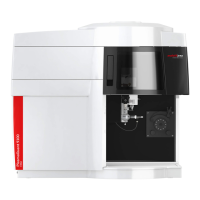
Essentially, the optical emission spectrometer consists of the following components:
¡ Components for plasma generation (HF generator, induction coil, torch)
¡ Sample supply system with hose pump, nebulizer and spray chamber
¡ Optical system with transfer optics, spectral photometer and detector
Both models, the PlasmaQuant PQ 9100 and the PlasmaQuant PQ 9100 Elite differ
with regard to their optical systems. The plasma generation and sample supply systems
are identical. The more powerful model, the PlasmaQuant PQ 9100 Elite
with high-res-
olution optics, is particularly suitable for interference-free analysis of samples in com-
plex matrices. Important application fields are the analysis of rare earths, of high-alloy
steel or petrochemical product. The standard model, the PlasmaQuant PQ 9100
,
achieves very good results in routine analysis despite its slightly low resolution.
Sample chamber and plasma
compartment
The sample introduction system is freely accessible in the sample chamber. The torch
and the induction coil, however, are located in the shielded plasma compartment to pro-
tect the user from the high-frequency radiation and the UV radiation from the plasma.
The spatial separation of sample supply and plasma also prevents the heat from the
plasma being transferred to the spray chamber without obstruction and causing a drift
there.


 To Next Page