LOADING AND SECURING
134
Operating instructions • Semitrailer • 505369471-04 • 02/2019
NOTE
Material damage caused by incorrect
use of straps!
Incorrect use of strapping belts, chains or
wire ropes can result in material damage
to the cargo.
► Only load straps to the maximum per-
mitted values.
► Immediately replace defective or dam-
aged straps.
► Have repairs on straps carried out by
qualified staff.
► Never tension straps and ratchets
over sharp edges.
► Do not use straps to lift cargo.
► Do not place any cargo on the straps.
► Do not twist or knot the straps.
► Do not use ratchet extensions, except
on heavy-duty ratchets designed for
this purpose.
NOTE
Material damage caused by uneven
tension force!
If the load is strapped down unevenly and/
or the lashing down is done with large
clamping forces, this can result in material
damage.
► Ensure that the pre-tension force is
evenly distributed on both sides of the
load.
► Apply the ratchets on alternate sides
when using tie-down lashing.
► For pressure-sensitive cargo (e.g.
beverage crates) that cannot be sub-
jected to high securing forces, use
large-sized angular rails. This allows
higher pre-tension forces to be ap-
plied without damaging the cargo.
Tie-down lashing, angular lashing, and di-
agonal lashing can be achieved with lash-
ing material such as lashing belts, lashing
chains, and lashing cables.
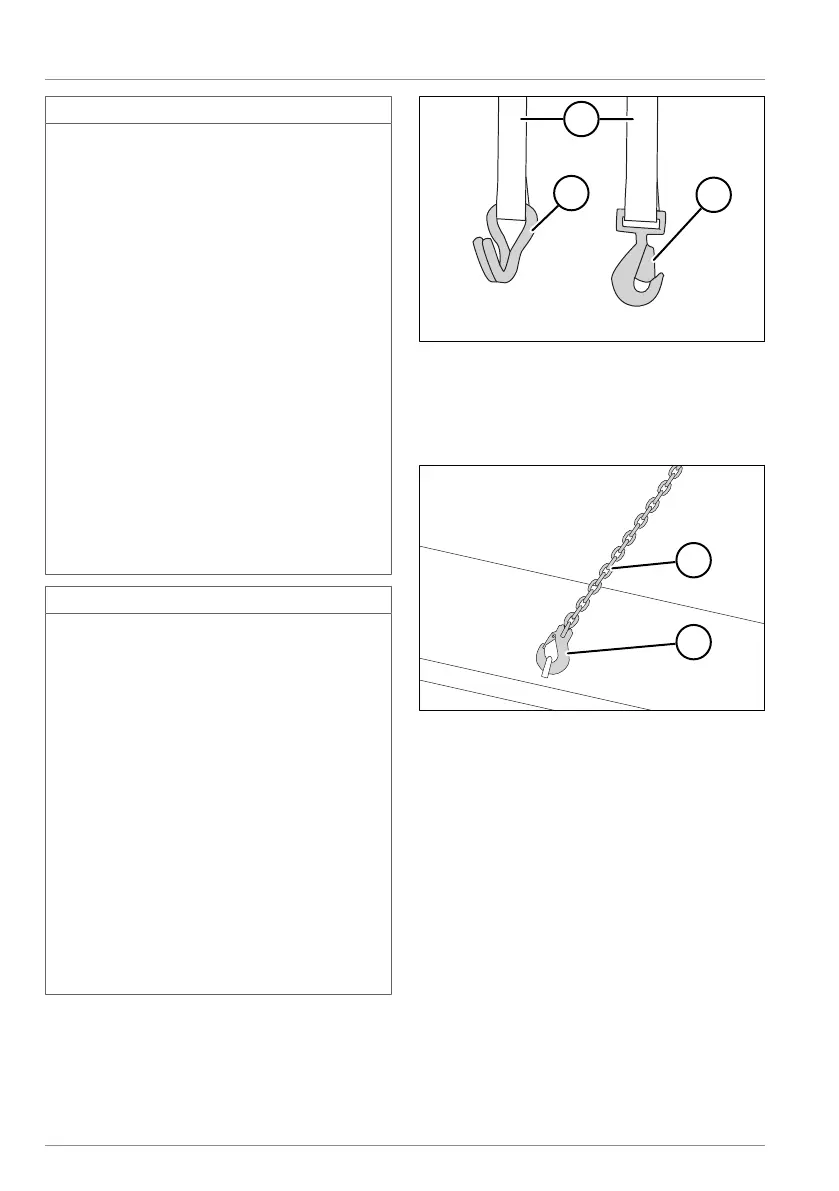
Fig.8-1: Lashing material
1 Wire hook
2 Lashing belts
3 Flat hook
Fig.8-2: Lashing chain with load hook
1 Lashing chain
2 Load hook
Wire hooks, flat hooks, and load hooks can
be used to fasten the straps.
With tie-down lashing, the securing effect
is achieved from pressure increase against
the load compartment. Angled and diag-
onal lashing prevents non-stable loads
from tipping over.



 To Next Page