LaCie 5big network RAID and Disks
User Manual page 54
RAID 105.6.
RAID 10 (also called RAID 1+0) is another RAID level that com-
bines the attributes of other levels, specifically RAID 1 and RAID
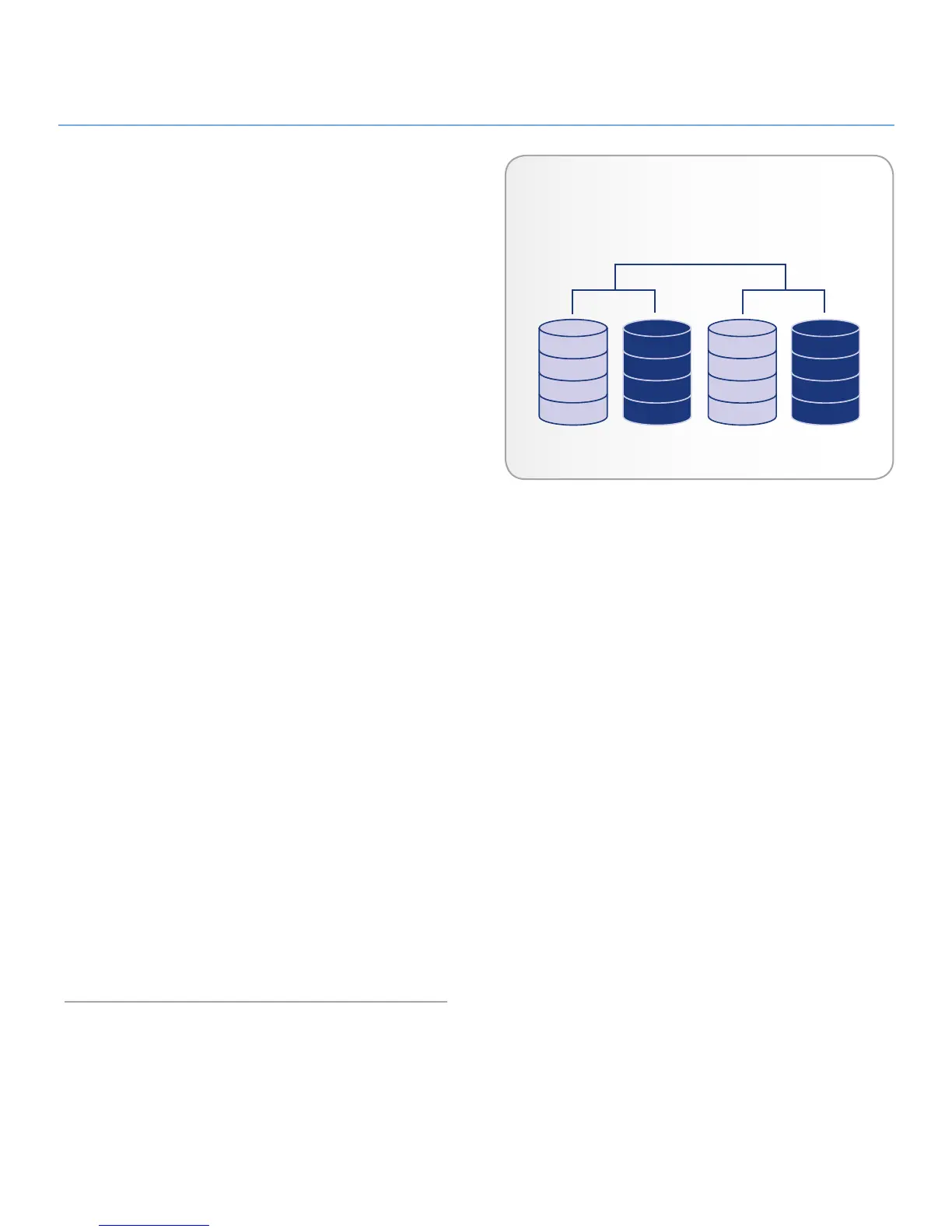
0. It is a “stripe of mirrored sets”, meaning that data is striped
across two mirrored arrays. The Striping occurs between arrays
and the mirroring occurs within the same array, which makes
the rebuilding very fast. RAID 10 arrays should have disks in
multiples of four. For LaCie products with five disks, in a RAID
10 array, the fifth disk will either be a spare or will be unused.
See the diagram at right.
In a RAID 10 array, one disk from each mirrored pair can fail
with no data loss. However, the working disk in an array with a
failed disk becomes a weak point for the entire array. If the sec-
ond disk in a mirrored pair fails, the entire array is lost.
Applications
RAID 10 provides good speeds because of RAID 0 striping, but
cuts the available capacity of a device in half (assuming all disks
in the array have the same capacity).
How RAID 10 Capacity Is Calculated
Each disk in a RAID 10 system should have the same capacity.
Storage capacity in a RAID 10 configuration is calculated by mul-
tiplying the number of drives by the disk capacity and dividing by
2, or
C = n*d/2
where:
C = available capacity
n = number of disks
d = disk capacity
For example, in a RAID 10 array with four drives each with a
capacity of 1000GB, the total capacity of the array would be
2000GB:
C = (4*1000)/2



 To Next Page