48 | 2-11 FireFighting
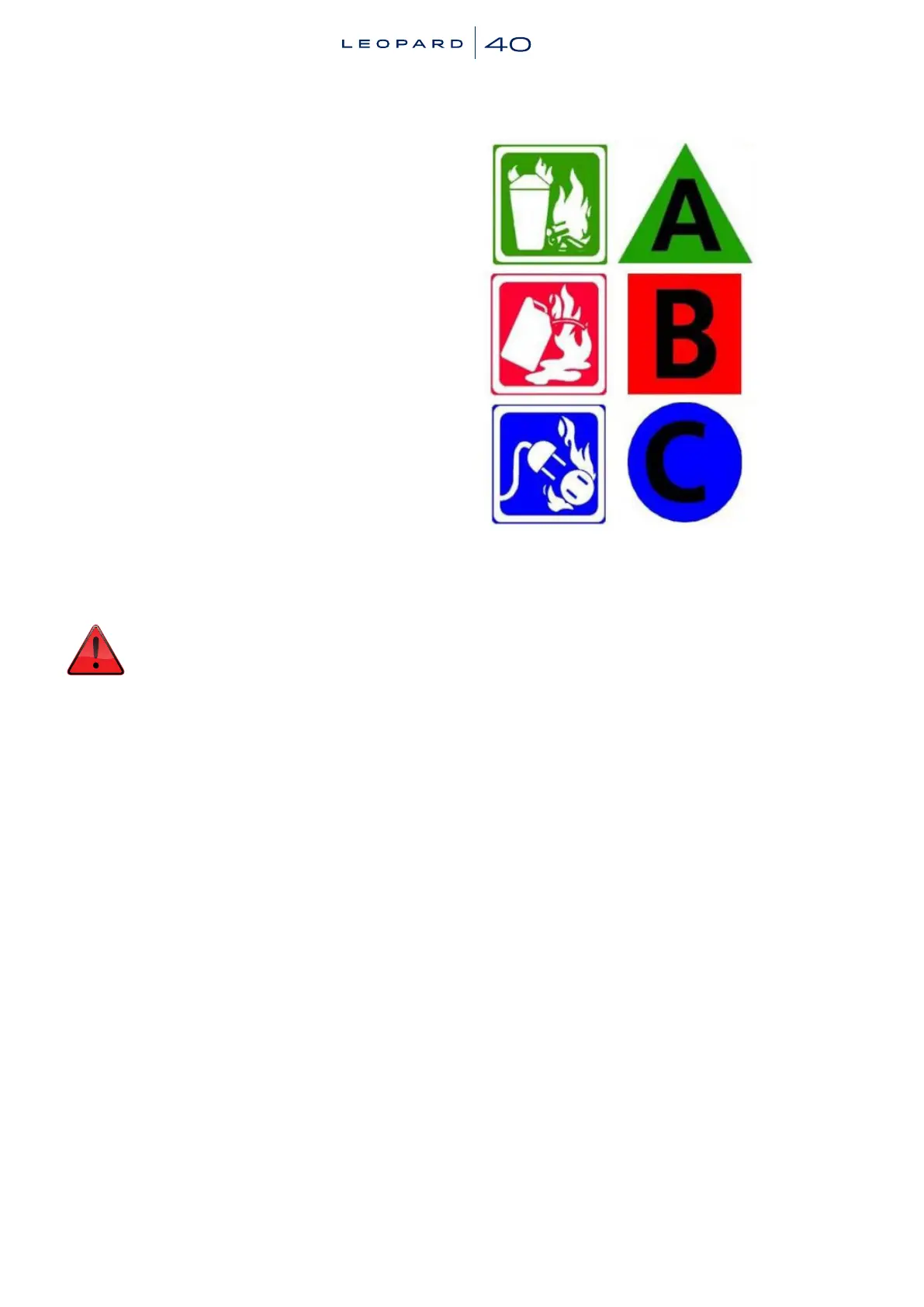
2-11.1 CLASSES OF FIRE
Class "A" Fires occur in ordinary
combustiblematerialssuchaswood,cloth,
paper,rubber,andmanyplasticsincluding
breglass reinforced plastics. Fires in
beddingandupholsteryareClass"A"res.
Class "B" Fires occurinammableliquids,
oils, greases, tars, oil-based paints,
lacquersandammablegases.Gasoline,
diesel, alcohol and kerosene res are
Class"B"res.
Class "C" Fires occur in energized
electrical equipment. The electrical non-
conductivity of the extinguishing agent is
important.Iftheelectricalequipmentisde-
energizedarelatedremaybeaClass"A"
or"B"reforthepurposeofreextinguishing
agentselection.
DANGER
2-11.2 EXTINGUISHMENT OF FIRES
Class "A" Fires - Water is the best means
of extinguishment and should be applied
assoonaspossible.Drenchthere,open
up the material to expose all burning
embers and drenchthem again,or throw
smouldering embers overboard. Multi-
purpose dry chemical, Halon 1211, and
Halo-carbon agents are also effective
agents.
Class "B" Fires - Halon, Halo-carbons,
dry chemical, and carbon dioxide are
suitableforClass"B"res.Ingeneralthe
extinguishingagent should bedirectedat
thebaseofthereworkinginahorizontal
sweepingmotionfromthefronttotheback
ofthere.
Class "C" Fires-ExtinguishmentofClass
"C"resmaybeaccomplishedwithcarbon
dioxide, dry chemical, Halon, and Halo-
carbonagents.Water-basedextinguishing
agentsshouldnotbeusedbecauseofthe
potentialdangerofelectricalshocktothe
re ghter and the possibility of short
circuitingtheelectricalcircuits.
LPG or CNG Fires:
Therearespecialconsiderationsregarding
resinvolvingliqueedpetroleumgasand
compressed natural gas.An uncontrolled
reinvolvingliqueedpetroleumgas(also
referred to asLPG, butane,propane and
sometimes brand names) or compressed
naturalgas(alsoreferredtoasCNG)will
usually occur when there is a leak or a
breakattheappliance,insupplylines,or
possibly at the cylinder outlet. The re
takestheformofaconcentratedmassof
ameadjacenttotheleakorbreakwhere
thefuelmixeswiththeairandburns.Itis
recognized that dry chemical or Halon
extinguishing agents may extinguish the
re, but if the fuel supply is not shut off
immediately, the extinguishment may set
the conditions for a greater hazard (i.e.,
explosion).


 To Next Page