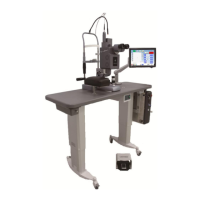
The LIGHTMED TruScan Pro Ophthalmic Laser is a Class IV laser product designed for various ophthalmic surgical treatments, including retinal photocoagulation, pan retinal photocoagulation, endo photocoagulation, macular treatments, and laser trabeculoplasty. It is classified as Class I type B electromedical equipment and a Class II medical device.
Function Description:
The TruScan Pro system generates a controlled laser beam with wavelengths of 532 nm (green), 561 nm (yellow), 577 nm (yellow), 670 nm (red), or 810 nm (infrared), depending on the configuration. This laser energy is delivered to the patient's eye tissue to produce photocoagulation effects, heating tissue to create thermal coagulation of protein. A red aiming beam (635-650 nm, <1 mW) is used for precise positioning of the treatment laser. The system features a microprocessor-controlled electronic system that performs self-tests to ensure proper functioning and safety. Two shutter modules block the laser beam path, engaging except when in "READY" mode and the footswitch is activated. A closed-loop control system ensures a stable output pulse.
Important Technical Specifications:
Console Laser System:
- Electrical Input: 100 to 240 VAC, 50/60 Hz, single phase.
- Power: 150 W (12 V @ 15 A, 24 V @ 7 A).
- Fuse Rating: T8AH250V @ 100 to 230 VAC (time lag).
- Operating Temperature Range: 15 to 30 °C.
- Relative Humidity Range: 10 to 95% non-condensing.
- Atmospheric Pressure: 800 to 1,100 mbar.
- Cooling System: Fan-cooled and thermoelectric cooling (TEC) for laser diode and crystal.
- Dimensions (W x L x H): System: 370 x 330 x 13 mm; Ophthalmic Table: 920 x 630 x 1400 mm; Portable Carrying Case: 780 x 530 x 280 mm.
- Weight: System: 13 kg; Packed: 20 kg.
Treatment Laser Specifications:
- Wavelengths (nm): 532, 561, 577, 670, 810.
- Laser Type: OPSL (532, 577), DPSL (561), Diode (670, 810).
- Mode of Operation: Continuous wave.
- Power Output:
- 0.05 to 2.0 W (maximum 2 W to patient's cornea) for 532, 561, 577 nm.
- 0.05 to 0.7 W (maximum 0.7 W to patient's cornea) for LIO and endoprobe.
- 0.05 to 3.0 W (maximum 2 W to patient's cornea via slit lamp, 3 W maximum to patient's cornea) for 810 nm.
- Exposure Duration: 10 ms to 90,000 ms (discrete steps).
- Repeat Interval: 10 ms to 10,000 ms (selectable, greater than or equal to exposure duration).
- SP Mode Duty Cycle Selections: 5%, 10%, 15%, 20%, 25%, 30%, 31.3%, 40% 'ON' time (25% and 31.3% for 810nm port2 only).
- Doctor Safety Filter: OD4 (OD6 for 810nm).
- Power Display Accuracy: Better than ±20% of actual power display.
- Beam Divergence: < 0.2 NA.
Aiming Laser Specifications:
- Laser Type: Red laser diode.
- Wavelength (nm): 635 (red).
- Mode of Operation: CW.
- Output Power: Maximum 1.0 W.
- Power Adjustment: Continuously variable.
- Safety Class: Class II.
LDU Specifications:
- Slit Lamp (CSO SL950):
- Microscope: Galilean.
- Pattern Scanning: Single, Line, Square (2x2, 3x3, 4x4, 5x5), Triangle, Circle (single, triple), Equal spacing (2x2, 3x3, 4x4, 5x5).
- Spot Sizes: Single spot: 50, 100, 200, 300, 400, 500 µm; Multi-spot: 100, 200, 300, 400, 500 µm (selectable on zoom assembly).
- Focus Plane: All spot sizes parfocal to slit lamp focus plane.
- Exposure Duration: Single spot: 10 to 3,000 ms; Multi-spot: 10 to 50 ms.
- Repeat Interval: Single spot: OFF, 10 to 3,000 ms (≥ exposure duration); Multi-spot: OFF.
- Beam Divergence: Cone angle of 20°.
- Magnification Set: 6-step drum rotation (5X, 8X, 14X, 24X, 36X).
- Eyepiece: 12.5X.
- PD Range: 48.5 to 80 mm.
- Diopter Adjustment: ±8.
- Slit Illumination: LED XLamp® XM-L2 2.85V 10W.
- Slit Width/Length: 0 to 14 mm.
- Slit Apertures: 0.3, 5.5, 9, 14 mm.
- Slit Angles: ±90°.
- Filters: Blue, Red, Green (red-free).
- Movement Ranges: Longitudinal (in/out): 113 mm; Lateral (left/right): 108 mm; Vertical (up/down): 35 mm; Fine movement range: 10 mm; Chinrest range: 70 mm.
- Optical Fiber Diameter: 200 µm.
- Optical Fiber Length: 2 m.
- LIO (Keeler All Pupil II / Keeler Vantage):
- Retinal Spot Size: 300 µm nominal (All Pupil II with 20D Laser Lens); 1100 µm +/- 20% (Vantage at 280mm).
- Illumination Power: From headset with LED illumination, also from laser console (internal PSU for intensity adjustment).
- Fiber Length: 3 m.
- Weight: < 500 g without laser attachment.
- Safety Filter: Fixed filter OD4.
- Beam Divergence: Cone angle 20°.
- Optical Fiber Diameter: 200 µm.
- Optical Fiber Length: 3 m.
- Endo-ocular Probes:
- Probe Types: Straight, Curved, Aspirating.
- Fiber Length: 3 m.
- Safety Filters: OD4 in housing (attached to operating microscope).
- Sterile: Sterilized by ethylene oxide, single-use device.
- Beam Divergence: < 0.2 NA.
Head-up Display (HUD) Specifications:
- Display Information: Power, Duration, Interval, Spot Size, SP Mode Duty%, Total shots.
- Interface: Type C.
- Dimensions: 190 mm (H) x 122 mm (W) x 79 mm (D).
- Weight: 520 g.
Usage Features:
- User Interface: The system is controlled via a Liquid Crystal Display (LCD) touchscreen with a menu bar, console control panel, and pattern scanner panel. A login password ("999") protects the software upon startup.
- Delivery Key System: Each Laser Delivery Unit (LDU) has a unique delivery key that must be inserted into the console for the system to recognize the LDU type and enable laser delivery. This ensures correct output power calibration for each LDU.
- STANDBY Mode: The system automatically enters "STANDBY" mode when turned ON, after 10 minutes of inactivity, or upon warning/error messages. In this mode, the footswitch is disabled, and the shutter blocks the beam path.
- READY Mode: Activating the "READY" button enables the footswitch and disengages the shutter, allowing the aiming beam to pass through. The laser fires only when the footswitch is pressed and must be released for subsequent shots.
- Power and Pulse Settings: Operators can adjust laser power, pulse duration, and interval. Default settings are 200 mW power, 20 ms pulse duration, and OFF pulse interval.
- Spot Size Adjustment: Spot size can be adjusted via controls on the slit lamp LDU (50 to 1,000 µm) and reflected on the LCD.
- Pattern Scanning: Available for all wavelengths, offering various patterns (single, line, square, triangle, circle, arc, curvature, rhombus) with adjustable radius, spacing, and rotation.
- 3D Mouse Control (Optional): An accessory for rotating patterns, toggling between pattern groups, and adjusting Power, Duration, Interval, and Aiming Beam Intensity.
- Patient Report: The system can generate patient reports, allowing entry of personal information and treatment parameters. Reports can be printed or uploaded to a DICOM server.
- Custom Contact Lens List: Users can add and modify contact lens options, which automatically recalculates fluence (J/cm²) based on magnification factor.
- Theme Color and Brightness: User interface color (black, blue, purple) and screen brightness are adjustable.
- Audible Warnings: The console produces an audible warning when the laser fires.
Maintenance Features:
- Minimal User Maintenance: The system is designed for minimal user maintenance, with simple routine procedures.
- Annual Service: Manufacturer recommends annual service by authorized Service Technicians for calibration, alignment, and general operating function verification.
- Earth Leakage Current and Resistance Measurement: Required annually according to EN60601-1, performed by authorized Service Engineers.
- External Surface Cleaning: Clean with a damp, non-dripping cloth and mild cleaning agent. Avoid solvents and direct spraying.
- Optics Cleaning: Gently wipe objective lens, illumination tower prism, eyepieces, and other slit lamp accessories with a moistened cotton tip or folded lens tissue (100% methanol or ethanol). Use a new tip/tissue for each wipe.
- Fiber Care: Optical fibers should be handled with care, avoiding bending into loops smaller than 200 mm, keeping them off the floor, and covering ends when not in use.
- Troubleshooting: The manual provides lists of error symptoms, warning messages, and error codes with corresponding descriptions and corrective actions. Users are advised to contact the Manufacturer or authorized Service Engineer for persistent issues.

 Need help?
 General

 To Next Page