RETeval-S Option
RET
eval
Device User Manual 32
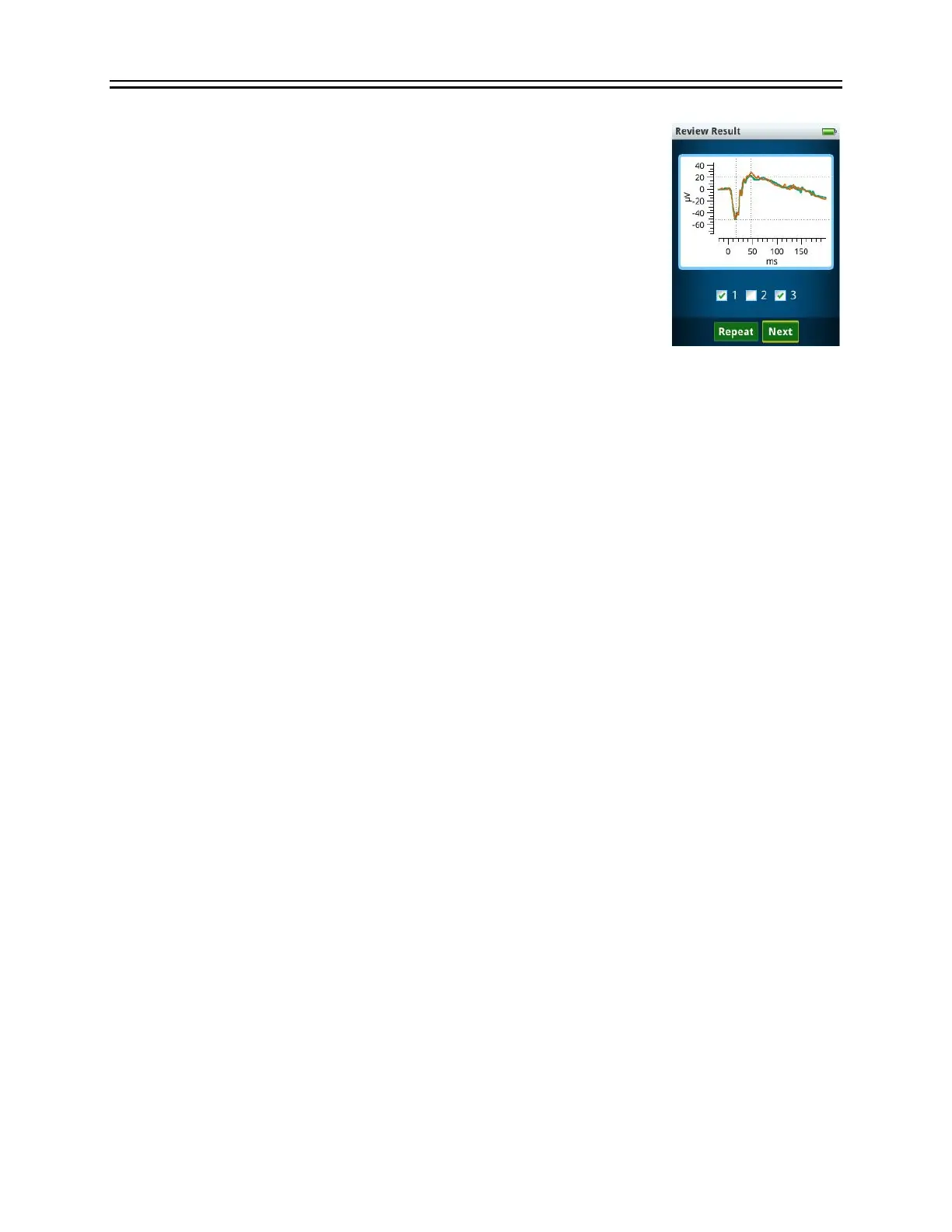
Subtests in protocols display the waveform results after each
measurement period and enable the operator to repeat the step as many
times as desired. Automated cursor placements are computed to the
average cursor placement across all repetitions. Any subtest can be
skipped without affecting the rest of the protocol. On the review screen,
the operator has the option of selecting which replicates to use on the
reports. This option enables replicates to be deleted in the event, for
example, of poor patient compliance or excess noise in some replicates.
To remove a replicate, simply uncheck the box associated with that
replicate. Replicates can be selected or removed anytime while
collecting replicates. After you have moved to the next test step, you no
longer can alter the replicate selection for previous steps.
For the dark adapted 0.1 Hz 85 Td·s and 3 cd·s/m² tests, oscillatory potentials and cursors are
reported. The oscillatory potential waveform is obtained by applying an 85 Hz – 190 Hz bandpass
filter. Up to 5 cursors are automatically placed on the oscillatory potential peaks and troughs
and are indicated on the report as black dots on the waveform. Implicit times (time to peak) and
amplitudes (peak to following trough) are reported for each individual cursor. The sums of
implicit times and amplitudes for all cursors are also reported. When interpreting the summed
cursor times and amplitudes, you should examine the cursor dots on the waveform to ensure
that no waves are missed.
For dark adapted tests, the display is automatically dimmed and reddened. The green power
status LED is also turned off to assist in dark adaptation. The display and LED are automatically
brightened at the end of the dark adaptation tests. See Backlight on page 9 to adjust the
brightness and color of the display during dark adapted portions of testing.
The signal processing for the non-flicker tests uses the followings steps. A zero-phase 0.3 Hz high-
pass filter reduces electrode drift and offset while preserving waveform timing. Measurements
from multiple flashes are combined to improve the signal to noise ratio using a trimmed mean to
reduce the effect of outliers after removing outlier replicates whose amplitudes exceed 1 mV.
The resulting waveform is then processed using wavelet-based denoising (Ahmadi and Rodrigo
2013) where wavelets are attenuated based on the signal to noise power between the post-
stimulus (signal) and pre-stimulus (noise) portions of the waveform. Oscillatory potential analysis
does not use the wavelet denoising.
The number of flashes combined is specified in the tables below. Because of the relatively few
flashes combined for the non-flicker tests, reducing the noise is more important in these tests;
consequently, skin preparation is suggested for all patients in order to reduce the electrode
contact impedance.


 To Next Page