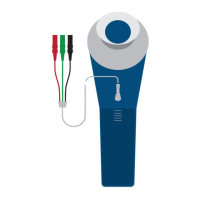
RETeval-S Option
RET
eval
Device User Manual 31
RETeval-S Option
The RET
eval
-S option provides a commonly-used set of flicker and flash protocols. These
protocols can be used to assess both rod and cone function. Protocols that test rod function will
take significantly longer to perform due to the dark adaption periods required. The device’s
patented technology enables measurements without dilating eye drops using real-time pupil size
compensation and uses skin electrodes (Sensor Strips). Other protocols use constant luminance
stimulation to match other ERG equipment.
Through a protocol chooser, the test protocol can be selected from 8 ERG testing options.
RET
eval
-S protocols
The RET
eval
-S device supports flicker and flash ERG testing. Brief flashes of light are provided
at the beginning of each stimulus period. For example, the built-in protocols use a stimulus
frequency of about 28.3 Hz. Background illumination, where present, uses a PWM frequency
near 1 kHz, which is well above the human critical fusion frequency and therefore is perceived as
steady illumination.
Some protocols provide dark adaptation timers as well as an approximate ambient light level
during the dark adaption. The ambient light level is approximated by taking the geometric mean
of the light level measured inside the integrating sphere (ganzfeld) by a photodiode with an
ambient light optical filter bonded onto it.
Some of the protocols have constant retinal illuminance, which are described by the Troland unit
(Td). These protocols are identified with “Td” in the user interface and PDF reports. In these
protocols, the RET
eval
device measures the pupil size in real time and continuously adjusts the
flash luminance to deliver the desired amount of light into the eye regardless of the size of the
pupil according to the following formula: Troland = (pupil area in mm
2
) (luminance in cd/m
2
).
Thus, pupils do not need to be dilated to achieve consistent results. Even when using mydriatics,
people dilate to different diameters and results can be made more consistent by using the
Troland-based stimuli. While Troland-based tests make results less dependent on pupil size,
secondary factors such as the Stiles-Crawford effect (Westheimer 2008) and/or changes in the
distribution of light on the retina prevent Troland-based tests from being completely
independent of pupil size (Kato et al. 2015, Davis, Kraszewska, and Manning 2017, Sugawara et
al. 2020). The built-in ISCEV Troland protocols attempt to match the ISCEV candela protocols by
assuming a 6 mm pupil diameter (28.3 mm
2
pupil area). For example, the Troland equivalent to
the dark adapted 3.0 ERG, which has a flash luminance of 3 cd∙s/m
2
, has a stimulus of
(3 cd∙s/m
2
)(28.3 mm
2
) = 85 Td·s. If the pupil diameter is 6 mm, the 85 Td·s stimulus will be the
same as a 3 cd∙s/m
2
stimulus and the resulting ERGs will therefore be the same.
There are cases where the stimulus compensating for pupil size may be inconvenient. These
protocols are identified with “cd” in the user interface and PDF reports. For example, the patient
cannot keep their eyelids sufficiently open for the device to measure the pupil, there is a desire
to stimulate the eye through a closed eyelid, or there is a desire to match the stimulus of a
previous publication. When looking for the presence of any retinal function, a bright constant
luminance stimulus may be sufficient.


 To Next Page