RETeval Flicker Option
RET
eval
Device User Manual 26
There are cases where the stimulus compensating for pupil size may be inconvenient. These
protocols are identified with “cd” in the user interface and PDF reports. For example, the patient
cannot keep their eyelids sufficiently open for the device to measure the pupil, there is a desire
to stimulate the eye through a closed eyelid, or there is a desire to match the stimulus of a
previous publication. When looking for the presence of any retinal function, a bright constant
luminance stimulus may be sufficient. Stimuli that do not depend on the pupil size are described
in terms of luminance (units of cd/m
2
) or luminance flash energy (units of cd∙s/m
2
). Stimuli having
flash luminance energies of 3 and 30 cd∙s/m
2
of white light (1931 CIE x, y of 0.33, 0.33) without
background illumination are provided. Additionally, a 3 cd∙s/m
2
white flash with a 30 cd/m
2
white background and its Troland equivalent (85 Td∙s with a 850 Td background) is provided to
match the flicker stimulus described in the ISCEV ERG standard (McCulloch et al. 2015).
The signal processing for flicker tests uses a Fourier-based approach and is described in Davis,
Kraszewska, and Manning (2017).
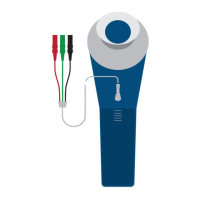
The ERG signal amplitude is lower with skin-contact electrodes such as Sensor Strips than with
corneal-contact electrodes. For ERGs recorded with the active electrode on the skin, signal
averaging is used. Skin electrodes may not be suitable to evaluate attenuated pathologic
electroretinograms. It is recommended that users recording electroretinograms should master
the technical requirements of their chosen electrode to obtain good contact, consistent
electrode positioning and acceptable electrode impedance.
Custom protocols
If there is a protocol that you would like to run that is not built-in, the RET
eval
device has support
for extending the number of options through custom protocols. Contact LKC (email:
support@lkc.com) for more information if you would like a custom protocol. Exemplary custom
protocols include replicate measurements, device-randomization of the presentation order of
multiple stimuli, changes in flash intensity, frequency, color, and/or duration, and extended-
duration stimuli such as on-off, ramp, and sinusoidal stimuli.
Custom protocols can be placed in the Protocols folder on the device. The built-in protocols can
be viewed on the device in the folder EMR/built-in protocols, which can be a starting point for
creating your own custom protocols. Protocols are written in the full-featured Lua programming
language.
Flicker test results
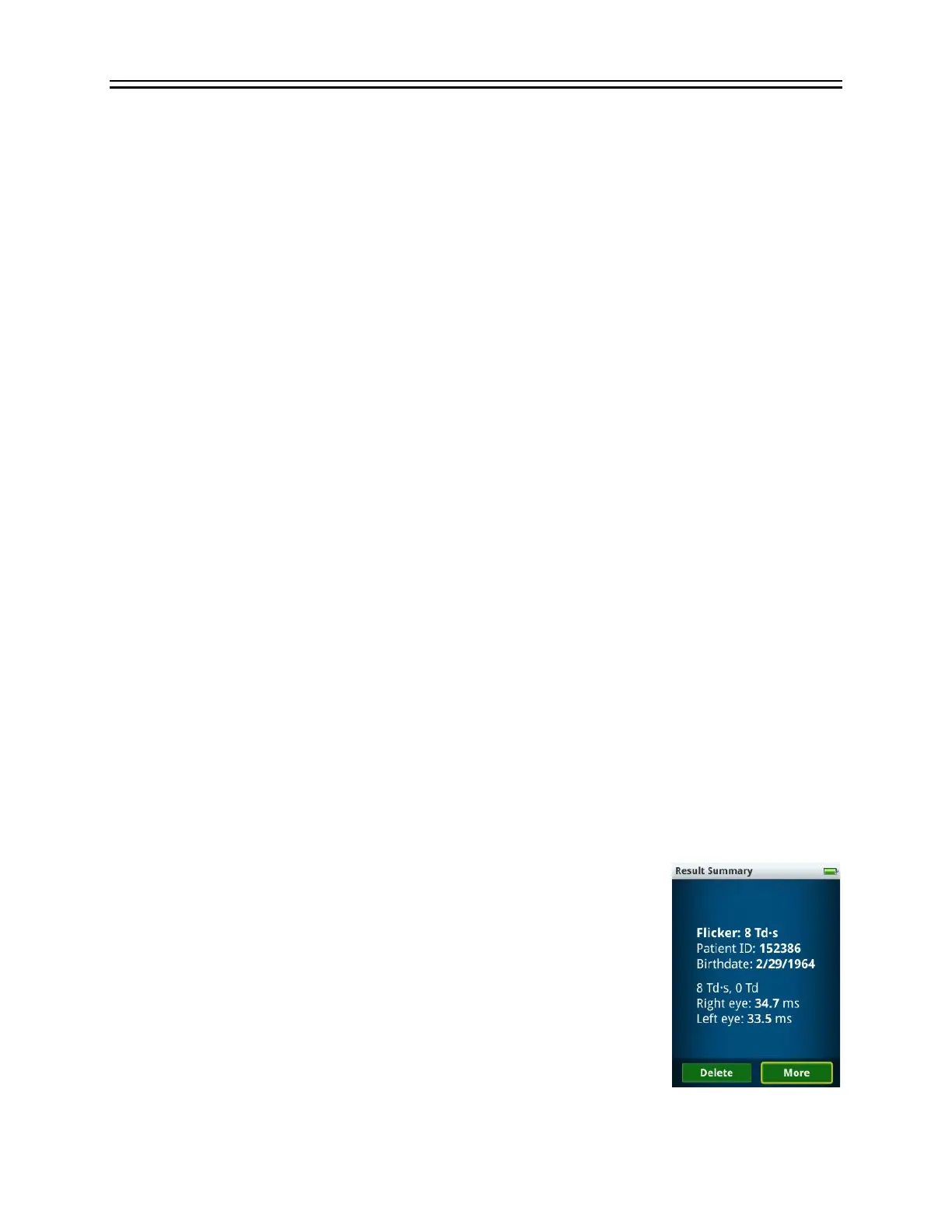
Results are shown on the RET
eval
device when the test is completed
successfully. Implicit times change substantially with flash intensity.
When referring to the literature for clinical interpretation, it is important
that your testing be done at the same flash intensity and background
light level. The ISCEV standard states that each laboratory should
establish or confirm typical reference values for its own equipment,
recording protocols, and patient populations.
After the test, a result summary is presented, as pictured above.


 To Next Page