RETeval Complete Option
RET
eval
Device User Manual 39
RET
eval
Complete Option
The RET
eval
Complete option makes the RET
eval
device a full-featured, ISCEV standard
compliant (McCulloch et al. 2015) ERG device. The DR Assessment protocol and the protocols in
the Flicker ERG option provide quick results for a number of diseases that can be assessed via
cone responses. Nevertheless, there are many other diseases for which a rod assessment and
single-flash assessments provide valuable insight into the state of the visual system. These
protocols will take significantly longer to perform due to the dark adaption periods required to
assess rod function.
Additionally, a protocol is provided for ISCEV-compliant flash VEP testing (Odom et al. 2010).
The ISCEV standard full field ERG measurements have been useful for a number of diseases.
Textbooks have been written (Heckenlively and Arden 2006, Fishman et al. 2001) as well as a
journal (Documenta Ophthalmologica) dedicated to clinical electrophysiology of vision.
Through a protocol chooser, the test protocol can be selected from single-flash options in
addition to the flicker options and the protocol specifically designed for vision-threatening
diabetic retinopathy.
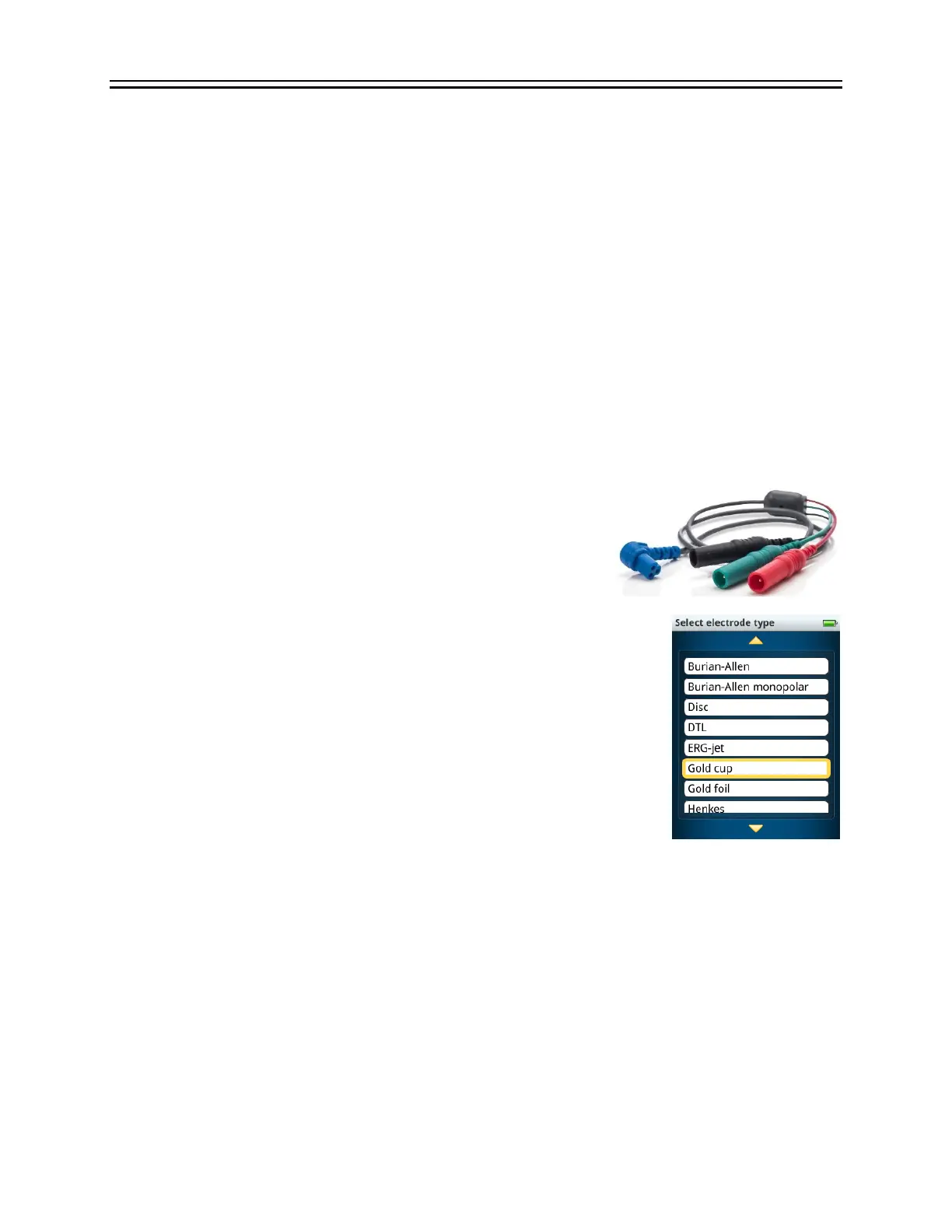
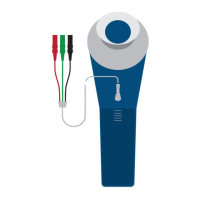
An adapter cable for DIN electrodes is provided with the RET
eval
Complete option, you can use any 1.5 mm safety DIN electrode
with the RET
eval
device. Chapter 17 in Heckenlively and Arden
(2006) enumerates many electrodes that are acceptable for ERG
recordings. Refer to the documentation provided by the electrode
manufacturer and in the ISCEV standards for proper placement, skin
preparation, cleaning, and disposal of these DIN electrodes. When
performing a test, the RET
eval
device will prompt the operator to
specify the electrode type. This information will be stored in the results
and appropriate normative data (when available) will be displayed. The
red lead is the positive connection, the black lead in the negative
connection, and the green lead is the ground / right leg drive
connection.
The ERG signal amplitude is lower with skin-contact electrodes such as
Sensor Strips than with corneal-contact electrodes. For ERGs recorded
with the active electrode on the skin, signal averaging is used. Skin electrodes may not be suitable
to evaluate attenuated pathologic electroretinograms. It is recommended that users recording
electroretinograms should master the technical requirements of their chosen electrode to obtain
good contact, consistent electrode positioning and acceptable electrode impedance.
RET
eval
Complete protocols
The RET
eval
device supports single-flash and flicker ERG testing. Brief flashes of light are
provided at the beginning of each stimulus period. A background light is also generated by
providing brief flashes of light at about 1 kHz, which is well above the human critical fusion
frequency and therefore is perceived as steady illumination. These protocols provide dark
adaptation timers as well as an approximate ambient light level during the dark adaption. The


 To Next Page