Choosing a protocol
RET
eval
Device User Manual 20
Choosing a protocol
The RET
eval
device enables you to change the stimulus conditions
(called protocols) to best meet your needs via a protocol chooser. The
flicker ERG option adds more than 10 protocols with varying flicker
stimuli. The RET
eval
complete option adds single flash stimuli protocols.
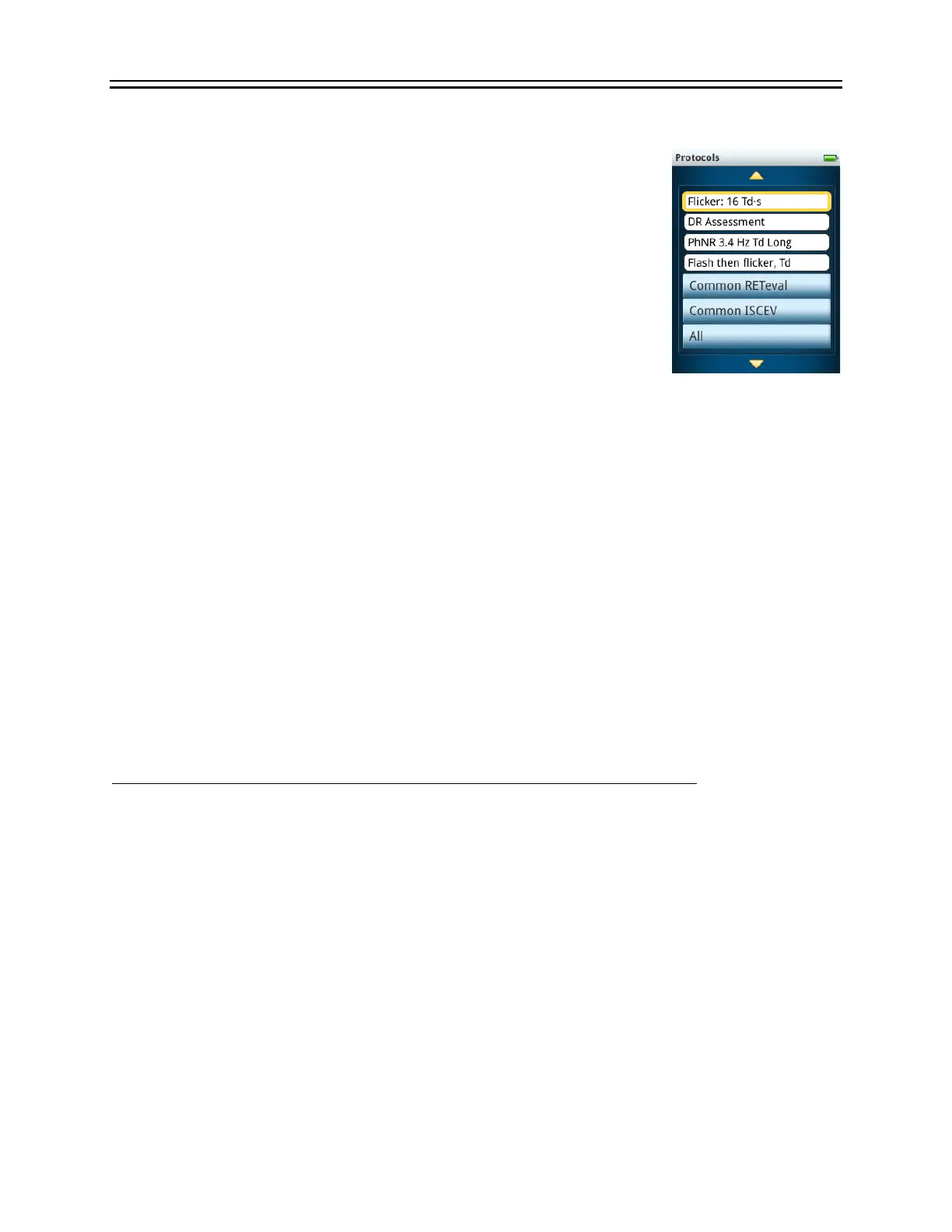
The choose protocol screen has the four most recently used protocols
and folders for protocols commonly used with the device, ones
recommended by ISCEV, custom protocols (if you have any), and all
protocols.
DR Assessment
The DR Assessment Protocol is designed to aid in the detection of vision threatening diabetic
retinopathy (DR), which is defined as severe non-proliferative DR (ETDRS level 53), proliferative
DR (ETDRS levels 61+), or clinically significant macular edema (CSME). This definition of vision-
threatening DR (VTDR) is the same as used in the NHANES 2005-2008 epidemiology study (Zhang
et al. 2010) sponsored by the United States National Center for Health Statistics (NCHS) and the
Centers for Disease Control and Prevention (2011).
The DR Assessment Protocol was developed using measurements of 467 people with diabetes
aged 23 – 88 (Maa et al. 2016). The gold standard, 7-field, color, stereo, ETDRS-compliant fundus
photography with non-physician expert grading (double-read with adjudication), classified each
subject into a severity group (Table 1) based on the subject’s worst eye. The study had a planned
oversampling of low-prevalence retinopathy levels, and the subject population included 106
diabetics with VTDR in at least one eye. The average testing time for the RET
eval
device during
the clinical trial was 2.3 minutes to test both eyes.
Table 1: Severity group definitions.


 To Next Page