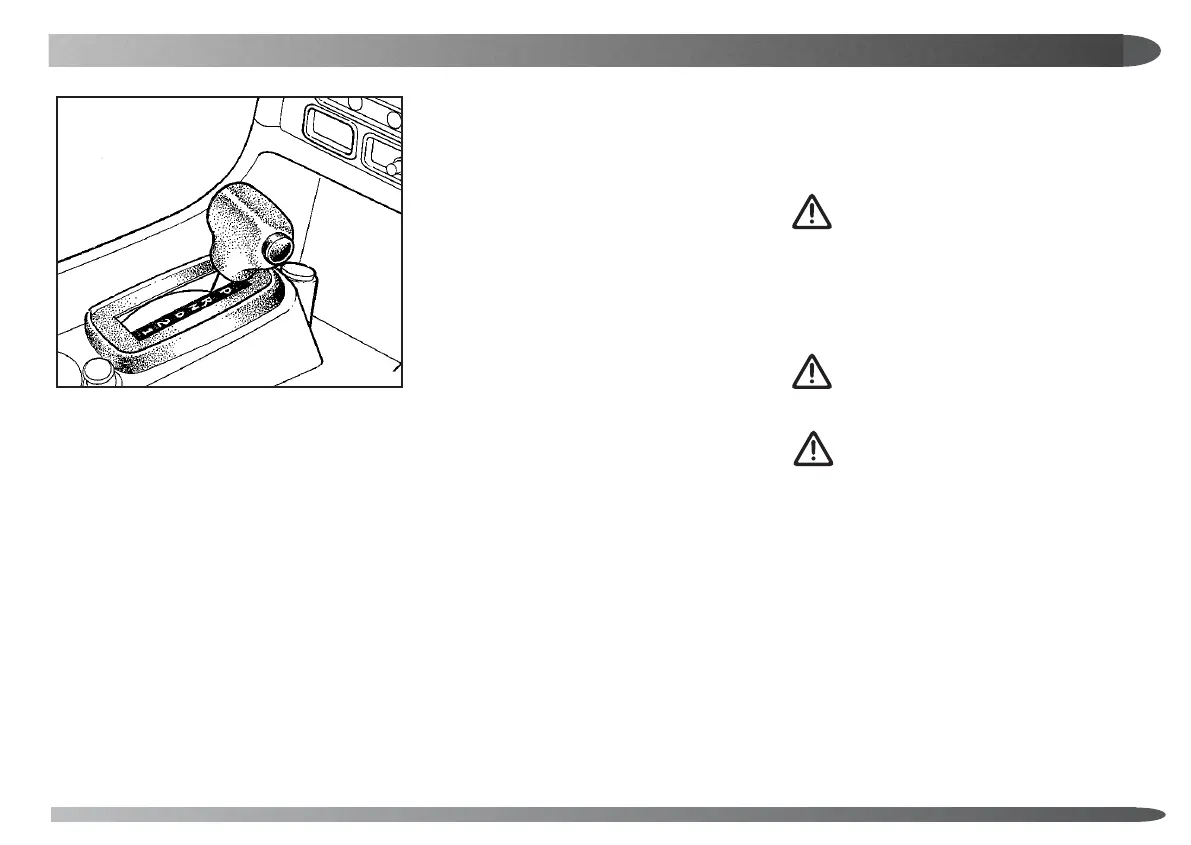
DRIVING THE VEHICLE
33
'N' - Neutral. Apply the brakes and select 'N'
when the vehicle has come to rest.
'D' - Drive. Select this position for normal
driving. Gears will change automatically both
upward and downwards through the forward
gears according to road speed and accelerator
position.
When the accelerator pedal is fully depressed,
the transmission will change down to a lower
gear if the road speed is sufficiently low to
permit the gear change; the transmission will
change up a gear when the accelerator is partly
released.
'2' - Second gear. May be selected directly
from 'D' Drive and will 'hold' the gear without
allowing a change to a higher gear. Select when
rapid acceleration is required without
depressing the accelerator pedal, or when
engine braking is required when descending
steep hills.
'1' - Low gear. Engagement of this gear is only
possible after pushing in the selector lock
button (G). This is to prevent accidental change
from 'D' directly into '1' (low gear). Use this
gear when climbing steep hills slowly, driving
slowly through deep snow, or for maximum
engine braking on very steep downhill grades.
Note: Engine braking is present in both '2' and
'1' gears
FILLING WITH FUEL
Always use the specified fuel for your vehicle.
To allow for expansion, do not fill the tank to the
top of the filler neck.
CAUTION: LOW FUEL CAN CAUSE
DAMAGE TO YOUR FUEL PUMP. To
avoid the need to 'bleed' air from the
fuel system, always avoid any possibility of
allowing the fuel tank to run dry. If the tank
should run dry, the fuel system must be
primed to exclude air (page 55) before
attempting to restart the engine.
CAUTION: The use of diesel/water
emulsion ‘Purinox/Aspira’ is
prohibited.
CAUTION: The use of diesel fuels with
high vegetable oil content of over 5%
is prohibited. This includes products
commonly described as Bio-Diesel. You must
use fuel that the retailer confirms is
manufactured to ISO/BSI/EN590 which is the
European standard for Mineral Diesel, for
Road Use.
EIV 0018



 To Next Page