DRIVING THE VEHICLE
34
BRAKES
The brakes on your new vehicle will increase in
efficiency as they are used during the first few
days of driving. During this 'bedding-in' period,
the pedal pressure required will diminish slightly.
Never impede brake pedal travel by using loose
additional and unsecured matting.
As a safety precaution, there are three brake
hydraulic circuits which operate independently.
Should one circuit fail, the other circuits will
operate though brake pedal travel will be
significantly increased. Push the brake pedal
down beyond the area of no resistance until the
second hydraulic circuit operates the brakes.
Do not 'pump' the brake pedal in an attempt to
restore pressure.
If the vehicle has been washed, driven through
water or over wet roads for long periods without
using the brakes, full braking power may not be
available until the brakes dry out. As soon as it
is safe to do so, dry out the brakes by applying
the footbrake lightly several times while the
vehicle is in motion. Keep the handbrake
applied when using washing equipment.
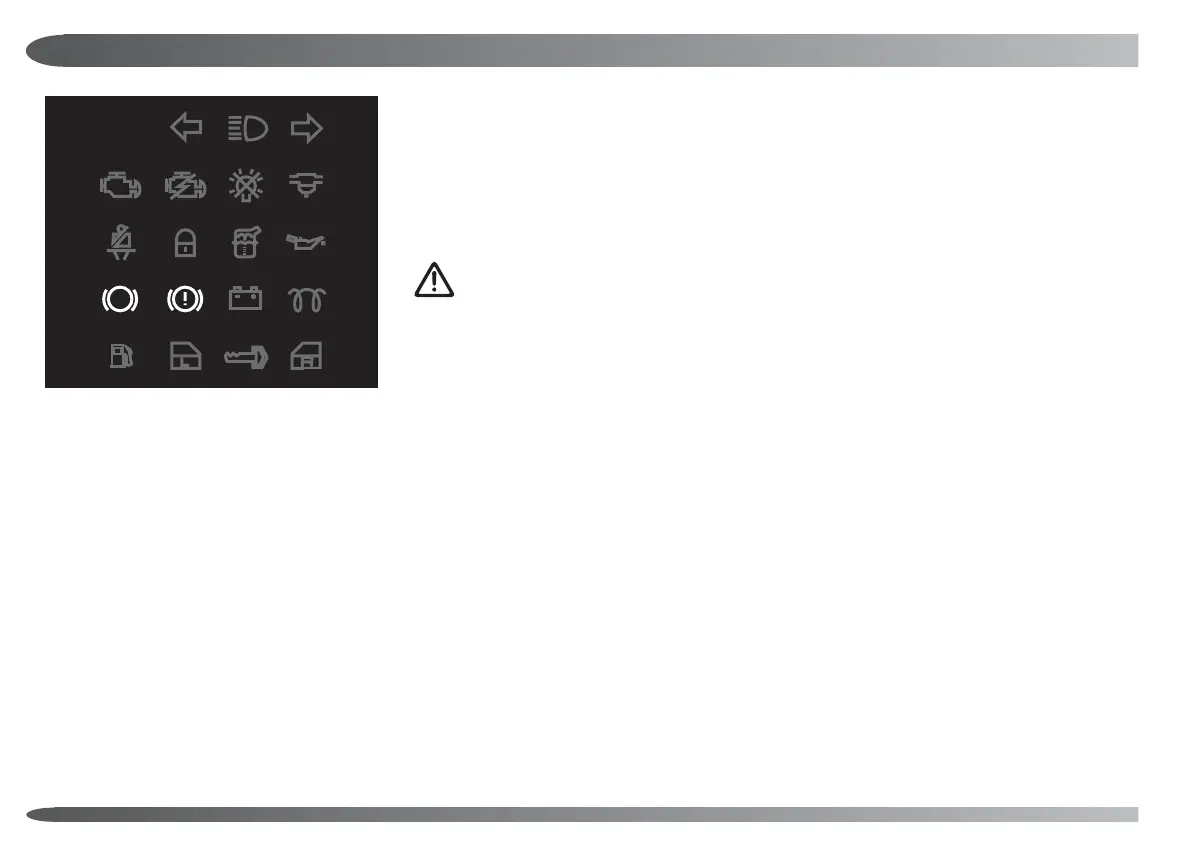
WARNING: Never ignore the braking
system warning light. If the light
glows at any time with the handbrake
released, it indicates a potential condition
with the braking system which requires
immediate investigation before the vehicle is
driven or after safely stopping the vehicle.
Check the brake fluid level has not fallen
appreciably, indicating a leak in the brake
hydraulic system. If the fluid level is incorrect,
the source of the leak must be corrected
immediately by an authorized LTI Vehicles
Dealer before the vehicle is operated further.
If the fluid level is correct, check to ensure
vacuum power assistance is available .
Low vacuum power assistance may be
identified by heavy brake pedal pressure. This
condition should be rectified by an authorised
LTI Vehicles Dealer.
If the brake fluid level and pedal effort are
correct, and the braking system warning light
comes on when the brake pedal is pressed, it
indicates that the front brake pads are worn and
should be replaced as soon as possible.
Anti-Lock Braking System
This system helps to prevent the road wheels
from locking and skidding during emergency
braking, assisting the driver to maintain full
steering and directional stability. The factor
controlling ultimate stopping distance and
cornering ability is tyre/road adhesion. ABS
optimises tyre/road adhesion under maximum
braking conditions though it cannot provide
increased cornering ability. There is no need for
special braking techniques, such as pumping
the brakes, to achieve optimum braking
distances and control on poor or slippery road
surfaces. Tyres must always be in good
condition to achieve maximum adhesion. During
normal braking the ABS will not be activated.
However, if the braking force applied begins to
exceed tyre/road adhesion, the ABS will
automatically activate preventing the road
wheels from locking. In these circumstances a
pulsating effect will be felt from the brake pedal
indicating that the system is functioning. The
pulsating effect is due to small fluctuations in
brake pressure supplied to the brakes by the
system to maintain full tyre/road adhesion.
Under severe braking on some road surfaces
tyre noise may be apparent even though the
wheels will at no time be locked.
ABS Monitoring
The ABS control module monitors the operation
of the system from ignition ON to ignition OFF. If
the lamp illuminates this will indicate a fault in
the anti lock braking system. The braking
system will continue to operate conventionally
and with the same standard as vehicles not
equipped with ABS.



 To Next Page