PASSENGER COMPARTMENT -
SEATS AND SEAT BELTS
39
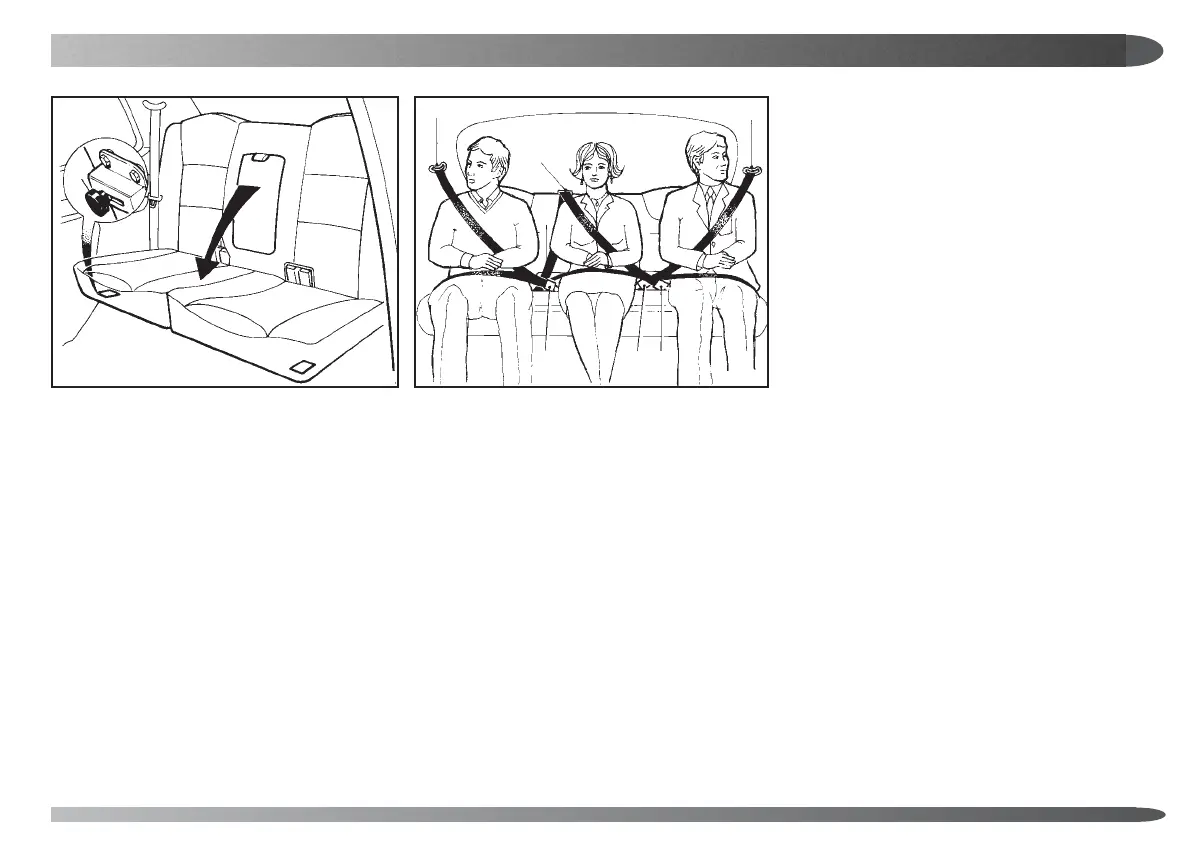
REAR SEAT
The rear seat is fitted with two cushions, each of
which may be hinged up when required to
provide extra manoeuvring space when loading
passengers in wheelchairs. The cushions should
normally be held down into position using the
latches provided (A).
The centre armrest may be pulled down as
required.
REAR SEAT BELTS
Three inertia reel seat belts are provided for the
rear seat.
The seat belt should be slowly drawn from its
retraction guide (B) on the body pillar (or, in the
case of the centre belt, from the fitment (C) on
the rear parcel shelf), passing it over the centre
of the right shoulder (left shoulder for the left
hand seat) before inserting the tongue on the
end of the belt into its buckle (D, E or F) until a
positive "click" confirms full engagement.
Ensure the belt is not twisted and position the
lap belt portion low over the hips (never across
the soft parts of the abdomen). Pull the shoulder
portion of the belt back towards the retraction
guide on the body pillar, or parcel shelf, to
remove any slack.
All models are fitted with a ‘Generation Belt’ in
the centre position. This can be used by an
adult or child. The diagonal strap may be
adjusted to the shoulder height of the occupant
by sliding the webbing guide (C) up or down the
understrap. For a large occupant the webbing
guide (C) should be on top of the seat back
cushion, whilst for a small occupant the
webbing guide (C) should be positioned about
50mm above the level of the shoulder.
Depress the red button on the buckle to release
the belt; the belt will retract automatically.
Note: The seat belts should be checked and
cleaned periodically as described on page 28.
WARE 52
WARE 53
B
B
C
D
F
E
A


 To Next Page