Metor 6M PAGE 37
Installation and Operating Manual
92102916 REV 5 8. CALIBRATION
Metor 6M contains various detection programs. It is recommended that you
compare different programs unless you select a program based on the requirements
of a security organization that you are familiar with. When comparing different
programs use various threatening and harmless objects relevant to your
application.
Test objects
When performing calibration use also several different threatening and harmless
objects relevant to your application.
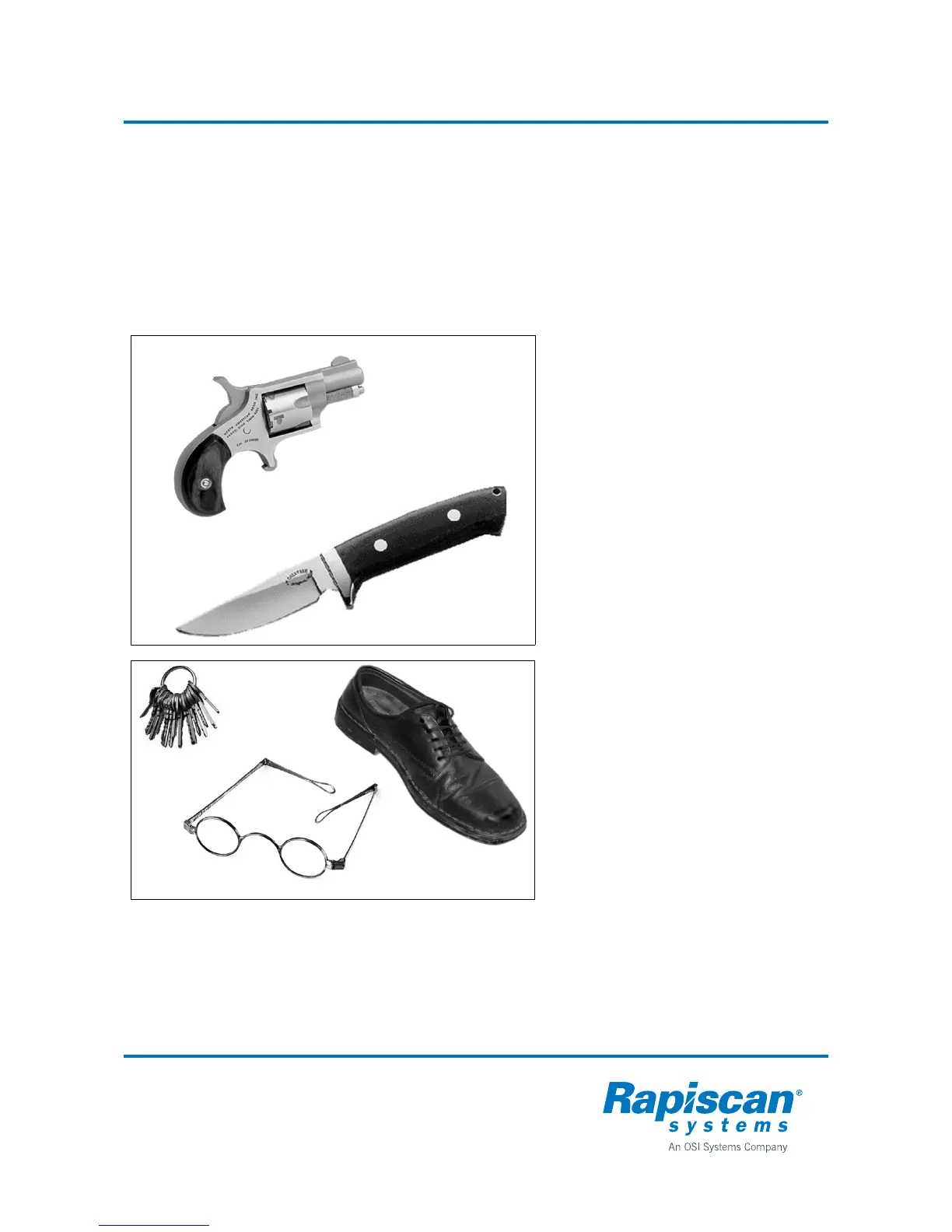
Choosing threatening objects
For the tests, choose the threatening
objects that are the most likely to be
detected. Usually these include various
hand guns or knives. Choose at least 3-5
different objects. The objects should be
made of different metals, both magnetic
and non-magnetic. (You can identify
magnetic metals and non-magnetic metals
using a magnet: a magnet attracts
magnetic metals but not non-magnetic
metals.)
Remember that the required detecting
sensitivity especially with small knives
made of non-magnetic metal is generally
considerably higher than that for the
detection of hand guns. This will also
increase the number of unwanted alarms
caused by harmless objects.
Choosing harmless objects
In addition to threatening objects, define
also a comprehensive set of harmless
objects that you can use for testing
discriminating capacity during calibration.
Harmless objects may include for example
footwear with metal reinforcing, a bunch of
keys, a belt buckle, eyewear with metal
temples etc.


 To Next Page