XTreme-EMS Operating Manual Page 32
Adjusting calibration points automatically
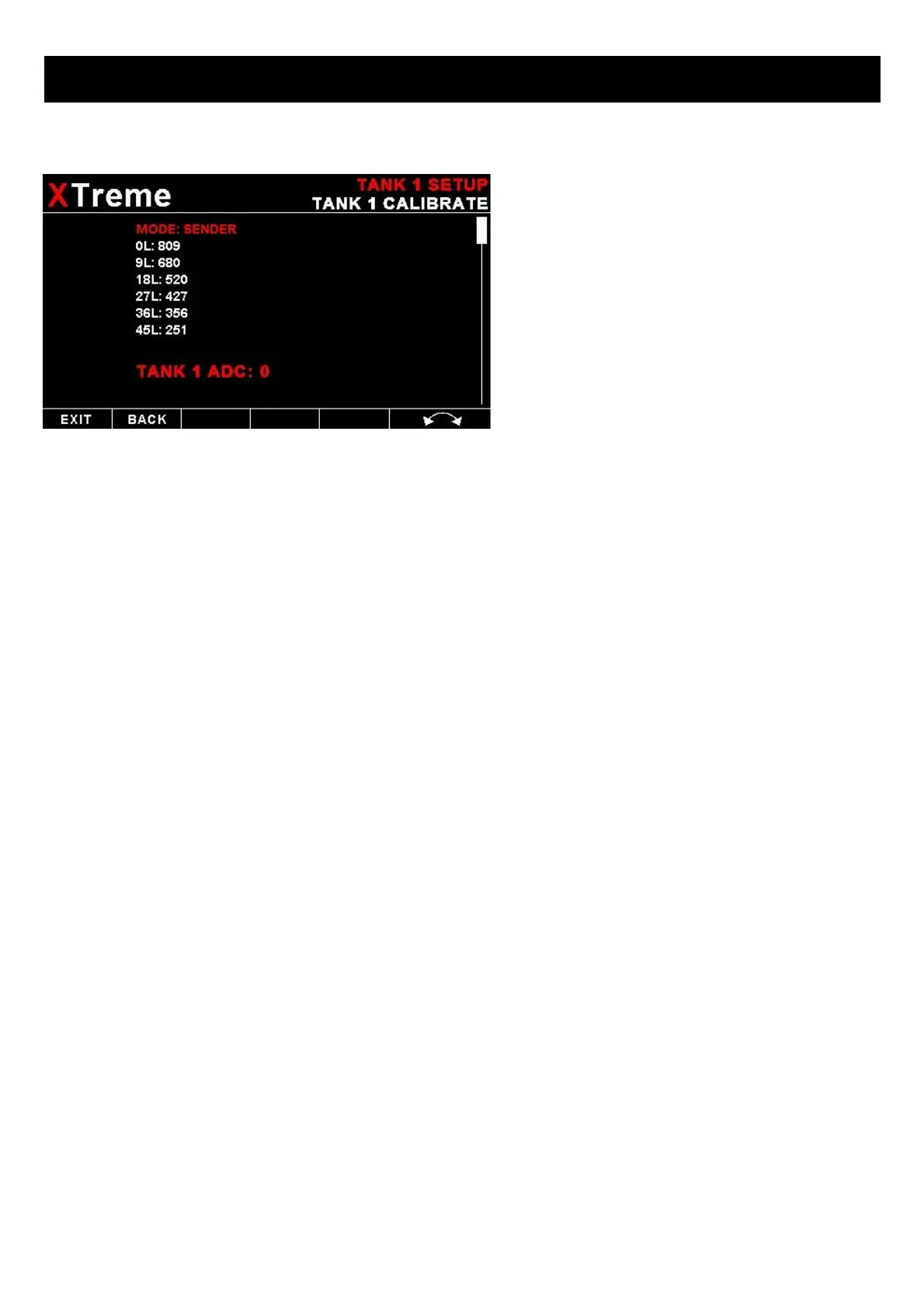
Select “SENDER” for the “MODE” menu item. Once you have installed a fuel level sender into your tank, make sure the
float can travel all the way from empty to full position without hindrance of any kind. The calibration procedure should be
carried out with your aircraft in flight attitude. This means you need to lift the tail if you have a tail-dragger or lift the nose
wheel if you have a weightshift trike.
Calibration procedure
Start the calibration procedure with an empty tank.
Add five liters of fuel (our reserve quantity) using a suitable measure. Make sure the measure is suitably
accurate. This is now the “level sender reading at 0 Lt” position. Move the highlight to this position and wait until
the sender reading has stabilized (You will see the sender reading at the top line). This could take up to a minute
so have patience.
ENSURE THAT THE FLOAT IS NOT SUBMERGED AND IS FLOATING ON TOP OF THE FUEL LEVEL.
Should this number not react to changes of your level sender position, then you have a problem. Please check
your wiring according to the installation section of this manual. You should expect the number to change in the
region of at least 20 to 60 counts per calibration position. If the number does not change with fuel level or only
changes a very small amount – check your installation. Something is not right!
• If you see the number changing then everything is well. Once it has stabilized and the highlight is on the 0 L
position, press the rotary control to transfer the reading from the sender to the calibration point.
• Now you are ready for the next step. Add the required amount of fuel to get to the next level (In our case 9 Lt – this
is 20% tank capacity). Once done, wait for the reading to stabilize and press the rotary control again after you
have moved the highlight to the “9 L” position.
• Proceed in a similar manner until you have reached the last calibration position at 100% tank capacity.
You are done!
The instrument uses the 6 calibration points to work out a correction curve that takes into account the tolerances of your
fuel level sender and the shape of your fuel tank. This results in an incredibly accurate and usable fuel level display that
far exceeds that available from ordinary dial type gauges.


 To Next Page