Witty User Manual - EN - v1.5 P. 72 / 171
4.4.5 TENNIS SHUTTLE
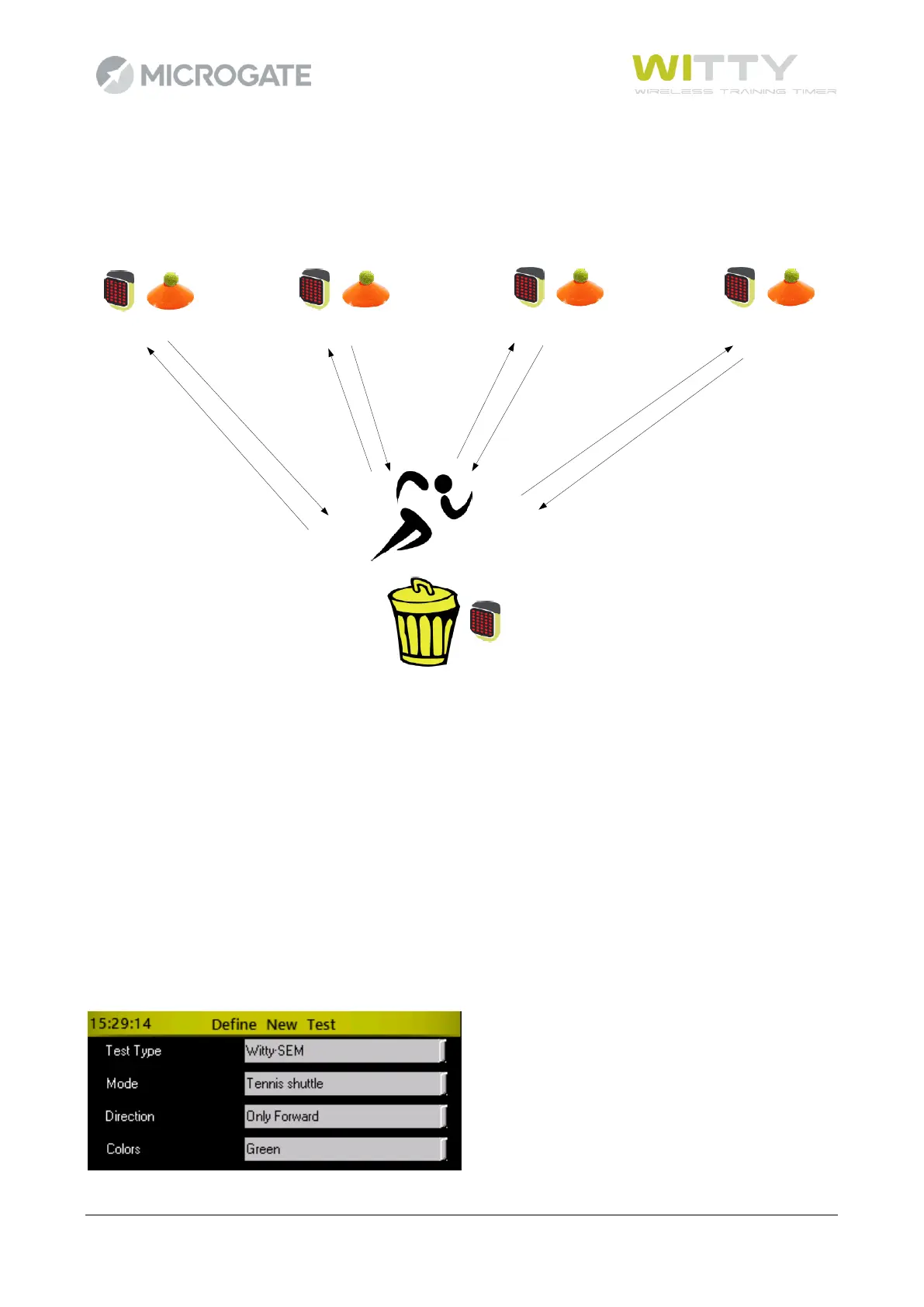
The name of this type of test is derived from a well-known exercise used in the tennis world, where 4 or more
cones are positioned with a tennis ball on top, which athletes have to fetch and bring back using a bucket
placed behind them.
Of course, instead of using cones, tennis balls and a bucket, we will use the WittySEM traffic lights, which will
have to be turned off by bringing a hand close to them. The first traffic light (the one that simulates the bin)
is optional and can be replaced by a cone or another item, to which the athlete must return each time.
The traffic lights all come on (with the full-LED symbol and in the set colour) and, for this test, there is no
need to follow a specific logic: the test will stop after N impulses (if Direction = Forwards Only) or (N*2) + 1
impulse (if Direction = Forwards/Backwards; +1 is the start one) with N=number of indicators.
Before starting the test, the Witty·TIMER scans the number of traffic lights present, therefore there is no
need to indicate how many there are.
Example: simulate the exercise described above, in which the athlete must touch the start traffic light (A)
and go to touch the B, C, D, E traffic lights in sequence, each time returning "to home base" by touching the
A traffic light. In some cases, the athlete is asked to make a specific gesture that is different for each route
(e.g. a jump from A-B, a push-up from A-C, a slalom from A-D, etc.).


 To Next Page