Doc# E107706 5 - 7
5: Communication Wiring
Electro Industries/GaugeTech
The Leader In Power Monitoring and Smart Grid Solutions
Electro Industries/GaugeTech
The Leader In Power Monitoring and Smart Grid Solutions
5.3.1: RS485 Connection
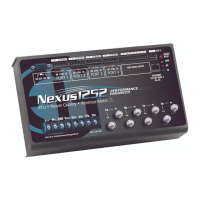
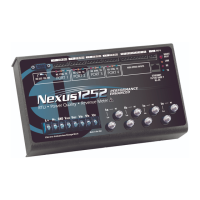
• Use any Port on the Nexus® 1250/1252 meter. If you use Port 1, set the selector
switch beneath the port to RS485.
• The link using RS485 is viable for up to 4000 feet (1219 meters).
• You must use an RS485 to RS232 converter, such as EIG’s Unicom 2500. See
sections 5.3.2 and 5.3.3.
• For information on connecting the Nexus® 1250/1252 meter to a modem, see
sections 5.8.2 and 5.8.3.
• Do not use the V(+)/V(-) pins: they supply power to the Nexus® displays and I/O
modules.
5.3.2: Connection to an RS485 Master (Unicom or Modem Manager)
• To establish communication between a Nexus® 1250/1252 meter and any RS485
master, such as EIG’s Unicom 2500, Modem Manager or other RS232/RS485
converter, use a shielded, twisted pair cable.
• Use an RS485 port (Ports 1–4) on the Nexus® meter. If you use Port 1, set the
selector switch beneath it to RS485. Connect the (+) and (-) terminals on the
meter to the (+) and (-) terminals on the master. Provide jumpers on the master,
linking its two (-) terminals and two (+) terminals. RS485 communication is viable
for up to 4000 feet (1219 meters).
• Connect the shield to the Ground (G) terminal on the Master. The (S) terminal on
the Nexus® meter is used to reference the Nexus® meter’s port to the same
potential as the source. It is not an earth-ground connection. You must also
connect the shield to earth-ground at one point. Vous devez également
connecter l’écran à la terre à un moment donné.
• Provide resistors at each end, connected to the (+) and (-) lines. RT is approxi-
mately 120 Ohms, but this value may vary based on length of cable run, gauge and
the impedance of the wire. See RT EXPLANATION in Section 5.3.


 To Next Page