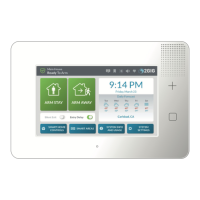
GC2e Wireless Security System | Installation and Programming Guide
©2020 Nortek Security & Control LLC. All rights reserved. 33 2GIG is a registered trademark of Nortek Security & Control LLC.
Sensor Types (Zones)
Each sensor (wireless or wired) installed in the system is programmed to a specic sensor number and sensor type (zone). The
sensor number idenes the specic sensor when it is displayed on the Control Panel, recorded in the event log, or reported to
the Central Staon. This allows pin-point informaon about any sensor in the system.
The sensor type determines how and when the Control Panel responds to signals from the sensor. Some sensors are armed all
the me, others are armed only in certain arming levels, some cause Central Staon Reports anyme they are acvated. The
sensor’s type, along with other programming opons, determine this.
Sensor Type (Zone) Descriptions
(00) Unused
This is the setting for unused sensor numbers that do not have a sensor programmed into them. No system action
occurs at any time from this sensor type.
(01) Exit/Entry 1
This sensor type is reserved for doors that are used for exit and entry of the protected premises. When the system is
armed in the Stay or Away mode, the exit delay timer starts. There is an exit delay regardless of whether the system is
armed in Stay or Away mode. When the exit delay timer expires, the system is fully armed.
With the system fully armed, when this type of sensor is triggered, the Entry Delay 1 timer starts. The system must be
disarmed before the Entry Delay 1 timer expires, or an alarm will occur.
If the entry delay timer is turned OFF during arming, the exit/entry delay sensors will act as non-delayed instant
sensors at the end of exit delay.
(02) Exit/Entry 2 This sensor type operates the same as the Exit/Entry 1 sensor type except it starts the Entry Delay 2 timer.
(03) Perimeter
This provides a method of having a longer entry delay on certain openings, such as a garage door, to provide the end
user more time to disarm the system.
This sensor type is for perimeter doors and windows that will not be used to enter or exit the protected premises while
the system is armed. An instant alarm will occur when this type of sensor is triggered with the system armed in either
the Stay or Away mode.
(04) Interior Follower
This sensor type is for interior sensors such as motion detector, interior doors, and other sensors that detect human
presence inside the protected premises. This type of sensor is called a “follower” due to its action when the system
is armed in the Away mode. After the exit delay expires and the system is armed, if an interior follower sensor is
triggered, an instant alarm will occur. If an exit/entry delay sensor is triggered first, the interior follower sensor will
also be delayed.
(05) Day Zone
Interior follower sensors are always bypassed and not active when the system is armed in Stay mode. This allows the
premises to be occupied while still protecting the perimeter.
This sensor type is the same as a perimeter zone, except when the system is disarmed, a violation displays a trouble
alert on the Console’s display. Common uses for this sensor type are protection of sensitive areas that require
notification and possibly a Central Station trouble report, but not an alarm when the system is disarmed.
(06) 24-Hour Silent Alarm
This sensor type is active independent of the system arming status. The code for silent panic is sent to the Central
Station, but for safety, there are no visual or audible indications locally that this sensor type has been triggered.
(07) 24-Hour Audible Alarm
This sensor type is continuously armed 24-hours a day. A sensor programmed to this type will trigger a local alarm and
the bell output regardless of the mode the system is in. Typical use would be an audible panic alarm.
(08) 24-Hour Auxiliary
Alarm
This sensor type is continuously armed 24-hours a day. A sensor programmed to this type will trigger an alarm
regardless of the mode the system is in. The bell output will not activate, but the local sounder will continue until
it’s acknowledged at the Control Panel. Typical use would be for a monitoring device such as a flood or temperature
sensor. There is no time out for the internal sounder, it will continue until a user code is entered.
(09) 24-Hour Fire †
This sensor type is continuously armed 24-hours a day. A sensor programmed to this type will trigger the local alarm
fire sounder and the bell output regardless of the mode the system is in. Typical use would be for wireless smoke
detectors. This sensor type is always active and cannot be bypassed.
(10) Interior with Delay
This sensor type operates as a delayed sensor when the system is armed in the Away mode, and when triggered, will
start the Entry Delay 1 timer. If the system is armed in Away mode with no Entry Delay (armed instant), this sensor type
will trigger an instant alarm.
(14) 24-Hour Carbon
Monoxide †
If the system is armed in Stay mode (or Stay mode with no Entry Delay), this sensor type will be bypassed.
This sensor type is continuously armed 24-hours a day. A sensor programmed to this type will trigger the local alarm
pulse sounder and the bell output regardless of the mode the system is in. Typical use would be for wireless carbon
monoxide detectors. This sensor type is always active and cannot be bypassed.
(16) 24-Hour Fire with
Verification †
This sensor type is continuously armed 24-hours a day. A sensor programmed to this type can trigger the local alarm
fire sounder and the bell output regardless of the mode the system is in. Typical use would be for wireless smoke
detectors. This sensor type is always active and cannot be bypassed.
For verification, this sensor type must be violated twice in two (2) minutes, or remain violated for 30 seconds. If any
other fire sensor (verified sensor type or not) violates within two minutes, both sensors will cause a fire alarm.
WARNING
THIS UNIT INCLUDES AN ALARM VERIFICATION FEATURE THAT WILL RESULT IN A DELAY OF THE SYSTEM ALARM
SIGNAL FROM THE INDICATED CIRCUITS. THE TOTAL DELAY (CONTROL UNIT PLUS SMOKE DETECTORS) SHALL NOT
EXCEED 60 SECONDS. NO OTHER SMOKE DETECTOR SHALL BE CONNECTED TO THESE CIRCUITS.


 To Next Page
 Loading...