33Northstar Explorer 650 Installation and Operation Manual
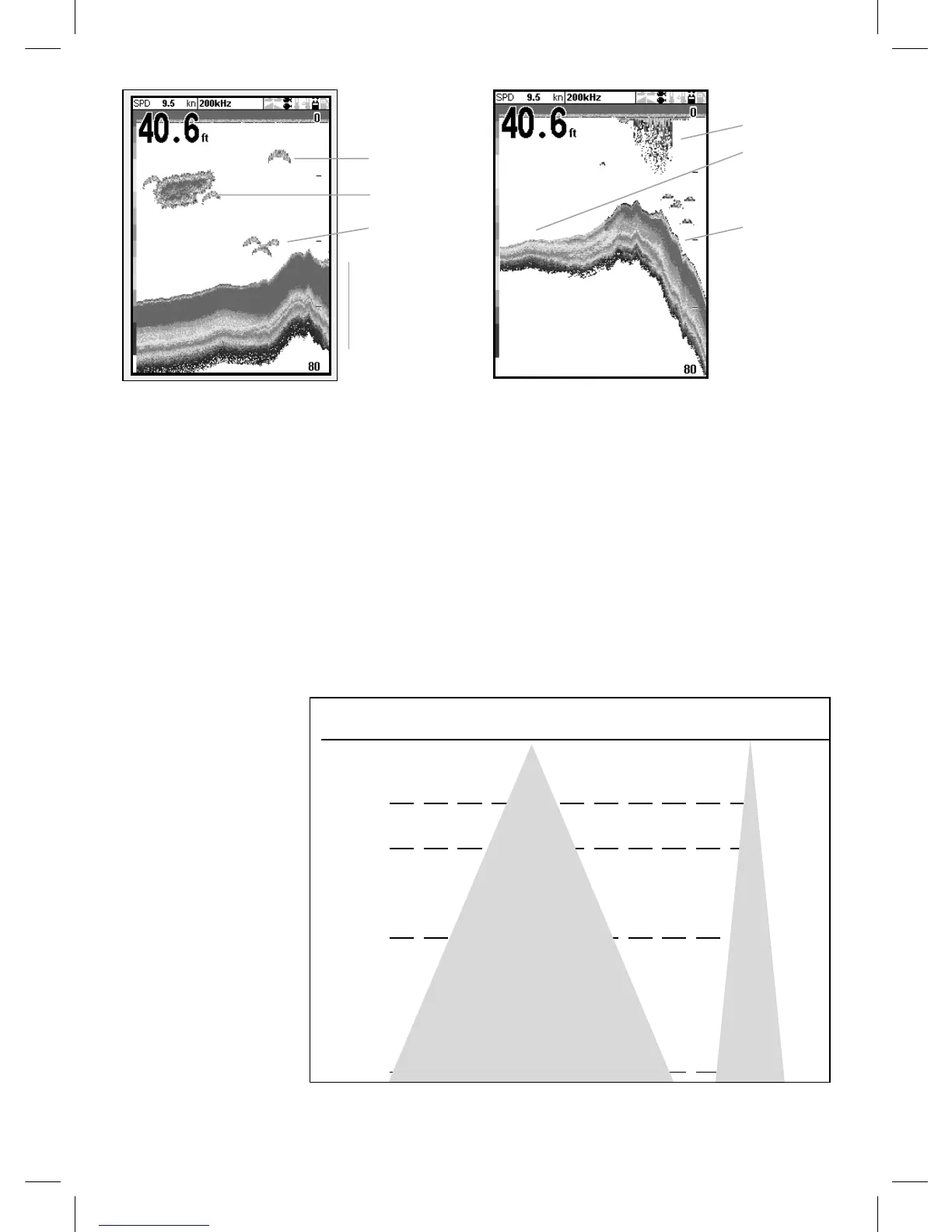
Bottom types
Mud, weed and sandy bottoms tend to weaken
and scatter the sonar pulse, resulting in a weak
echo. Hard, rocky or coral bottoms reflect the
pulse, resulting in a strong echo.
A
C
D
B
A Single fish
B Large school of fish
C Small school of fish
D Bottom
A Kelp / Weed
B Soft bottoms such as mud, weed and sand
show as narrow bands
C Hard bottoms such as rock or coral show as
wide bands
A
C
B
Frequency and cone width
Water Cone width Cone width
Depth at 50 kHz at 200 kHz
25 20 5
50 40 10
100 80 20
150 130 30
200 170 40
300 250 60
400 330 80
600 500 120
800 660 150
1000 830 190
45° cone
11°
cone
The sonar pulse
generated by the
Explorer transducer
travels down through
the water, spreading
outwards in a cone
shape. The cone width
is dependent upon the
frequency of the pulse; at
50 kHz it is approximately
45°, and at 200 kHz it is
approximately 11°.
The differences in the
cone width affect what is
displayed. See
section 8-3.



 To Next Page