register, all conditions will be reported in the standard event summary
bit. At the moment, you have to write a decimal value by using the *ESE
command to set the enable register mask.
※
Note 1: The errors in the DMM’s error queue except reading the error
queue by using SYSTem:ERRor? will be recorded by an error condition
(including bits 2, 3, 4 or 5 of the standard event register).
※
Note 2: In both the standard event register bit 3 and the questionable
data event register bits 0, 1 or 9, a reading overload condition can be
reported all the time. But in the DMM’s error queue, no error message
will be recorded.
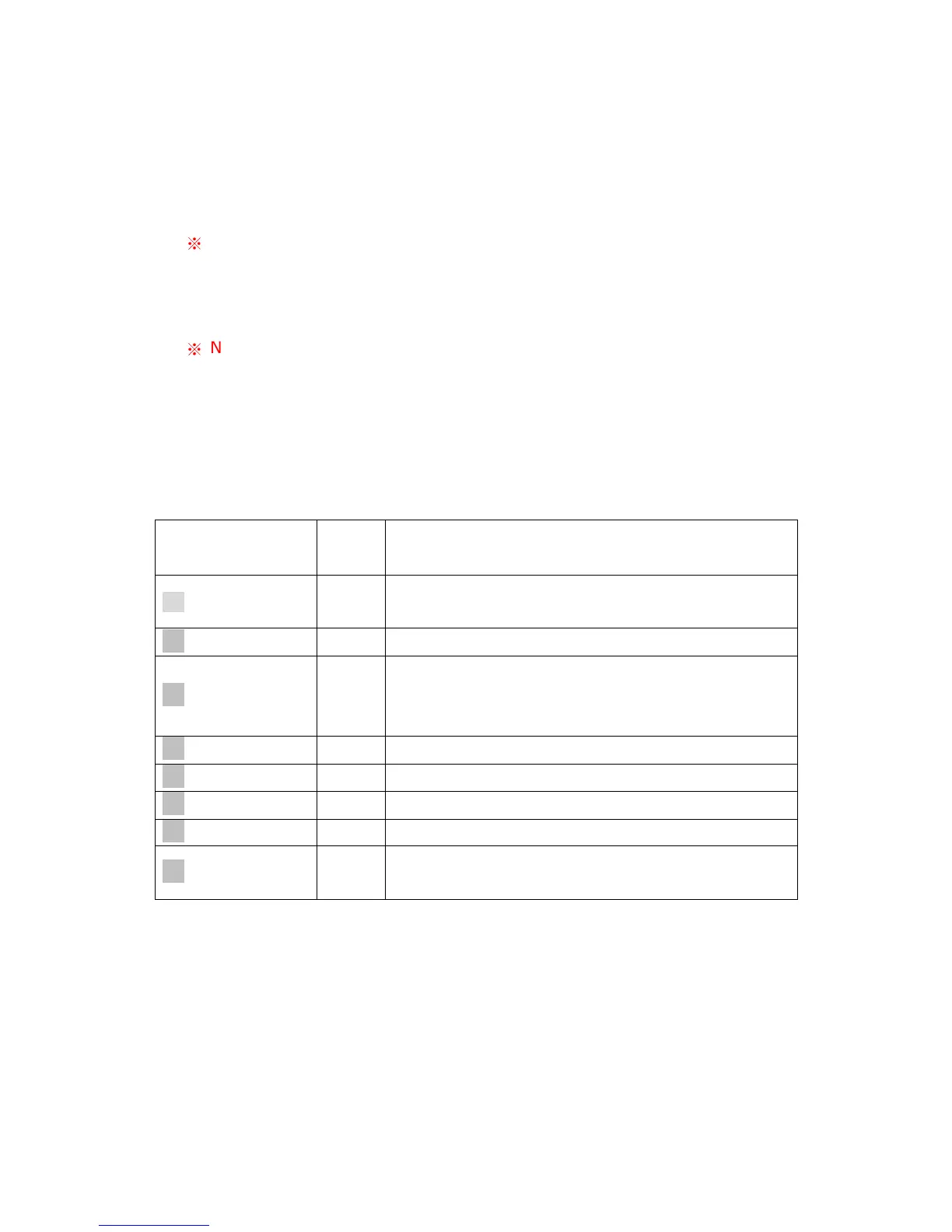
Bit Definitions for Standard Event Register
Bit
Decimal
Value
Definition
0.
Operation Complete
1
All commands prior to and including an *OPC command have been
executed
1.
Not Used
2
Set to 0.
2.
Query Error
4
The DMM output buffer was empty as the DMM tried to read from it.
Or a new command line was received before a previous query has
been read. Or, both the input and output buffers are full.
3.
Device Error
8 Error occurrence from a self-test, calibration or reading overlaod.
4.
Execution Error
16 Error occurrence from an execution.
5.
Command Error
32 Error occurrence from a command’s syntax.
6.
Not Used
64 Set to 0.
7.
Power On
128
Since the last time the event register was read or cleared, power has
been turned off and on.
The following conditions will clear the standard event register.
You send a *CLS command.
You query the event register by using the *ESR? command.
The following conditions will clear the standard event enable register.
You turn on the power, and have set the DMM previously by using
the *PSC 1 command.


 To Next Page