www.poolpak.com | 800-959-772512 | MPK Series - Installation, Operation and Maintenance
PoolPak units have active airflow monitoring and control using variable speed fans and air flow monitoring station to
provide optimal airflow at lower cost.
Room Dew Point Control
The PoolPak CPCS controller operates using an advanced type of control utilizing dew point and dry bulb
temperature. This method of control is more accurate than conventional relative humidity control. The main purpose
of a dehumidification system is to maintain the amount of moisture in the pool area below a level that would cause
damage to the building. Relative humidity is a measurement of the percentage of moisture in the air at a given
dry bulb temperature in proportion to the maximum amount of moisture that could be contained at this particular
dry bulb temperature. Warmer air can hold more moisture than colder air and, therefore, changes in dry bulb
temperature will change the relative humidity reading without any change in the actual amount of moisture in the
air. The amount of moisture in the air is expressed as “grains of moisture per pound of dry air” and is directly related
to the dew point temperature.
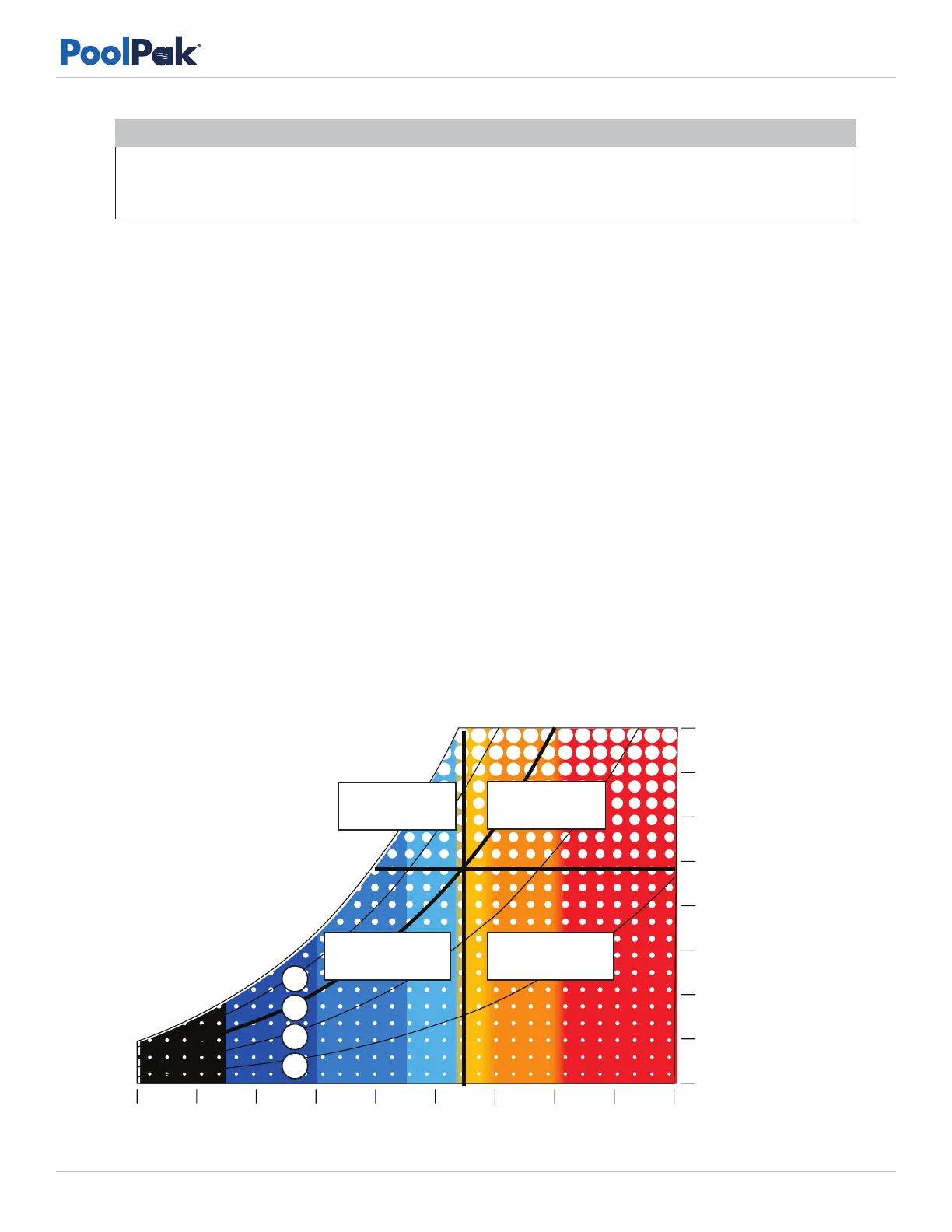
See Figure 2-1 for reference. The CPCS uses dew point control to operate the PoolPak unit and maintain the moisture
level below the setpoint. The space dry bulb temperature and relative humidity determine the dew point temperature.
By varying the space temperature and space relative humidity set points, the dew point set point is changed. When
the space dew point temperature rises more than 1/2 degree Fahrenheit above the space dew point temperature set
point, the CPCS controller energizes the compressor for dehumidification. As the dew point temperature drops more
than 1/2 degree Fahrenheit below the dew point temperature set point the controller de-energizes the compressor.
When the outside air is to be introduced into the space for ventilation, adequate exhaust capacity via an integral
(or a separate external fan) must be specified to ensure the poolroom remains slightly negative. An inadequately sized
exhaust system may result in damage to the structure and pool odors may be forced into other areas of the building.
! CAUTION
80%
60%
40%
20%
If RA here, space
too cold, too humid
If RA here, space
too cold, humidity OK
If RA here, space too
hot, humidity OK
If RA here, space
too hot, too humid
0.000
30˚F/-1˚C
Dry Bulb Temp.
40˚F/4˚C 50˚F/10˚C 60˚F/16˚C 70˚F/21˚C 80˚F/27˚C 90˚F/32˚C 100˚F/38˚C 110˚F/43˚C 120˚F/49˚C
0.030
0.028
0.024
0.020
0.016
0.012
0.008
0.004
Humidity Ratio
lb
w
/ lb
a
Dew Point
82˚F / 28˚C
80˚F / 27˚C
75˚F / 24˚C
70˚F / 21˚C
65˚F / 18˚C
60˚F / 16˚C
55˚F / 13˚C
50˚F / 10˚C
45˚F / 7˚C
40˚F / 4˚C
35˚F / 2˚C
30˚F / -1˚C
Figure 2-1. Dewpoint Control Psychrometric


 To Next Page