© 2017 PoolPak LLC. All rights reserved. MPK Series - Installation, Operation and Maintenance | 13
PoolPak
®
MPK Series IOM
PoolPak Operation
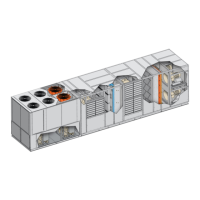
See Figure 2-2 to illustrate the following paragraphs.
Refrigerant-Side Operation
The PoolPak® draws in warm, moist air from the pool enclosure. This air passes through the evaporator
(dehumidification) coil and gives up heat energy to the refrigerant which is in a cool, liquid state. This exchange of
energy causes the air temperature to fall below its dew point, resulting in moisture condensation on the evaporator
coil. The moisture formed is collected by the unit’s condensate drain system. After passing through the evaporator
coil, the refrigerant becomes a cool gas.
The refrigerant enters the unit’s compressor, where it is compressed into a hot gas. While in the compressor, the
refrigerant absorbs the energy used to operate the compressor. This hot gas refrigerant then travels either through an
air reheat coil, the pool water condenser or to an optional auxiliary air condensing heat exchanger, which may be
either air or water cooled. If air heating is required, the air reheat coil is used. The hot refrigerant exchanges energy
with the cooler, dehumidified air coming from the evaporator coil. This causes the temperature of the air to rise for
heating.
If pool water heating is required the hot gas flows into a pool water condenser, where it adds energy to the
incoming pool water. This heats the pool water while the refrigerant is condensed into a warm liquid. If space
cooling is required, the refrigerant flows to the auxiliary air conditioning condenser bypassing the air reheat coil
and pool water condenser and allowing cool air from the evaporator coil to provide space cooling.
Air-Side Operation
The PoolPak system provides outside air ventilation to satisfy minimum air ventilation requirements during occupied
periods per ASHRAE standard 62.1.
The MPK unit can include an outside air damper (S), a factory mounted exhaust fan (SE), or an exhaust and purge
fan (SEP).
SEP models have an economizer function that can modulate up to 100% exhaust air and outside air. This operation
allows the unit to use outdoor ambient conditions if they are favorable for free heating, cooling, or dehumidification.
For a more detailed description of economizer and smart economizer operation, see the CPCS control functions
section.
The PoolPak unit has been designed to best recycle the energy from the return air during mechanical
dehumidification. In cooling modes for units employed with an exhaust fan (SE & SEP models), warm natatorium air
is exhausted before the evaporator coil. On the other hand, in heating modes for units employed with purge fans
(SEP and SP models), warm natatorium air is exhausted after the evaporator coil. This allows the unit to capture the
exhaust air heat energy for heating before exhausting the air to ambient.
An available supply of outdoor air and continuous air movement is required for indoor air quality. Therefore,
PoolPak does not recommend turning off the unit.


 To Next Page