H - I - J PROGRAMMER’S MANUAL V8.94.11-
- 29 -
Explanation, further submenus
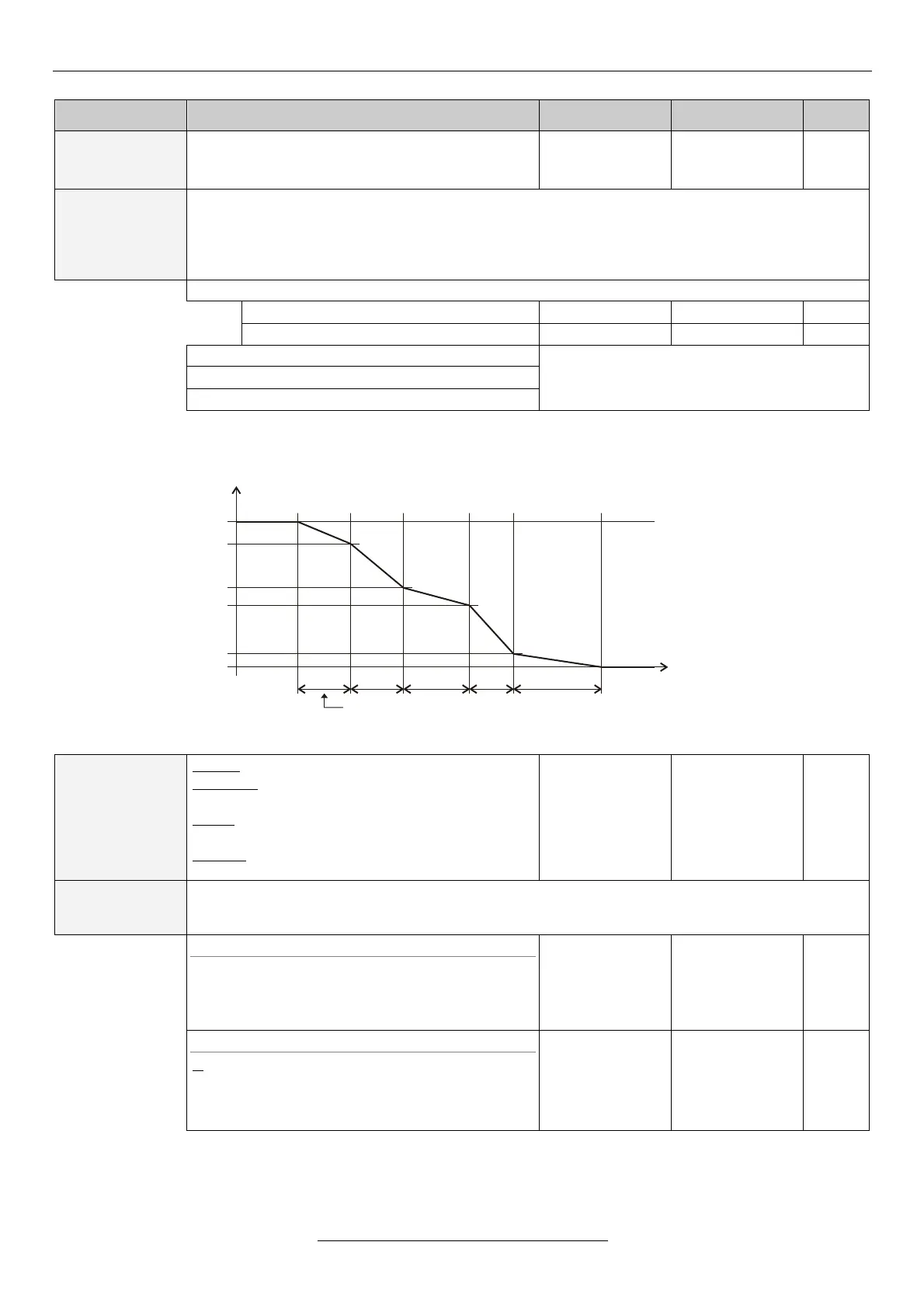
Deceleration without breakpoint (normal) and with
breakpoint (multistep deceleration) can be
selected.
3-3
multistep
deceleration
Duration is the time necessary to decelerate from the prescribed frequency to the previous one.
The starting point of the characteristics is 0 Hz. If the last frequency (f4) is lower than fmax, then
between f4 and fmax the deceleration occurs with the normal slope. The deceleration consists of
linear sections. If the prescribed frequency is lower than the previous one, it will be disregarded by
the program!
3-3-1 first breakpoint (0 Hz f1)
3-3-2 second breakpoint (f1 f2)
The setting is the same as that of item
3-3-1 first breakpoint
3-3-3 third breakpoint (f2 f3)
3-3-4 fourth breakpoint (f3 f4)
Explanation of the deceleration with breakpoints
normal: It means running down the frequency.
DC brake: Switching a standing field to the
motor.
mixed: Combination of the normal and the DC
brake.
free run: The equipment leaves alone the
motor.
normal brake
DC brake
mixed
free run
Degree of the increase of the actual motor terminal voltage during generator operation mode.
The loss of the motor increases but the braking dynamics increases. If even this is not enough for
the demanded braking effect, additional resistor brake is to be used!
3-6-1 over excitation
With increasing this value, the dynamics of the
braking increases but in extreme case it may also
cause overcurrent and the equipment stops with
error message.
3-6-2 excitation time
N: The overexcitation voltage will be switched to
the motor with a sudden jump.
By increasing the excitation time forming of
overcurrent can be decreased.
stop
f
ref.sign.
T
down
t4 t3 t2 t1
At frequencies above f4 corresponds to the basic setting
f4
f3
f2
f1


 To Next Page