The system will be activated when the TPMS receiver
module detects a change in tire pressure. The ignition
must be in the RUN mode, with the transmission in
PARK (P).
The Hazard Warning flashers will come on to confirm
the vehicle is in Tire Fill Alert mode.
If the Hazard Warning flashers do not come on while
inflating or deflating the tire, the TPMS sensor may be
in an inoperative position, preventing the TPMS sensor
signal from being received. In this case, the vehicle may
need to be moved slightly forward or backward.
When Tire Fill Alert mode is entered, the tire pressure
display screen will be displayed in the instrument
cluster.
Operation:
•
The horn will chirp once when the selected pressure
is reached to let the user know when to stop inflat-
ing or deflating the tire.
•
The horn will chirp three times if the tire is overin-
flated or over deflated and will continue to chirp
every five seconds if the user continues to inflate or
deflate the tire.
•
The horn will chirp once again when enough air is
added or removed to reach proper selected pres-
sure level.
Tire Pressure Information System (TPIS)
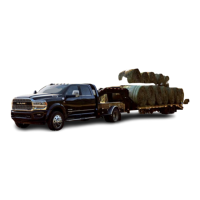
3500 Series Trucks
Your vehicle may be equipped with a TPIS.
The TPIS uses wireless technology with wheel rim
mounted electronic sensors to transmit tire pressure
levels. Sensors mounted to each wheel as part of the
valve stem transmit tire pressure readings to the
receiver module.
NOTE:
It is particularly important for you to check the tire pres-
sure in all of the tires on your vehicle monthly and to
maintain the proper pressure.
The TPIS consists of the following components:
•
Receiver module
•
Four TPMS sensors (Single Rear Wheel (SRW)
applications)
•
Six TPMS sensors (Dual Rear Wheel (DRW)
applications)
•
Pressure display in the instrument cluster
The TPIS will display all four (Single Rear Wheel (SRW)
applications) or six (Dual Rear Wheel (DRW) applica-
tions) tire pressure values in the instrument cluster
display.
If a system fault is detected, the instrument cluster will
display a "SERVICE TPM SYSTEM" message for a mini-
mum of five seconds and then display dashes (- -) in
place of the pressure value to indicate which sensor is
not being received.
If the ignition switch is cycled, this sequence will repeat,
providing the system fault still exists. If the system fault
no longer exists, the "SERVICE TPM SYSTEM" message
will no longer be displayed, and a pressure value will
display in place of the dashes. A system fault can occur
due to any of the following:
•
Signal interference due to electronic devices or driv-
ing next to facilities emitting the same radio fre-
quencies as the TPMS sensors.
•
Installing aftermarket window tinting that contains
materials that may block radio wave signals.
•
Accumulation of snow or ice around the wheels or
wheel housings.
•
Using tire chains on the vehicle.
•
Using wheels/tires not equipped with TPMS
sensors.
OCCUPANT RESTRAINT SYSTEMS
Some of the most important safety features in your
vehicle are the restraint systems:
OCCUPANT RESTRAINT SYSTEMS
FEATURES
•
Seat Belt Systems
•
Supplemental Restraint Systems (SRS) Air Bags
•
Child Restraints
Some of the safety features described in this section
may be standard equipment on some models, or may
be optional equipment on others. If you are not sure,
ask an authorized dealer.
IMPORTANT SAFETY PRECAUTIONS
Please pay close attention to the information in this
section. It tells you how to use your restraint system
properly, to keep you and your passengers as safe as
possible.
Here are some simple steps you can take to minimize
the risk of harm from a deploying air bag:
SAFETY 219
6



 To Next Page
 Loading...