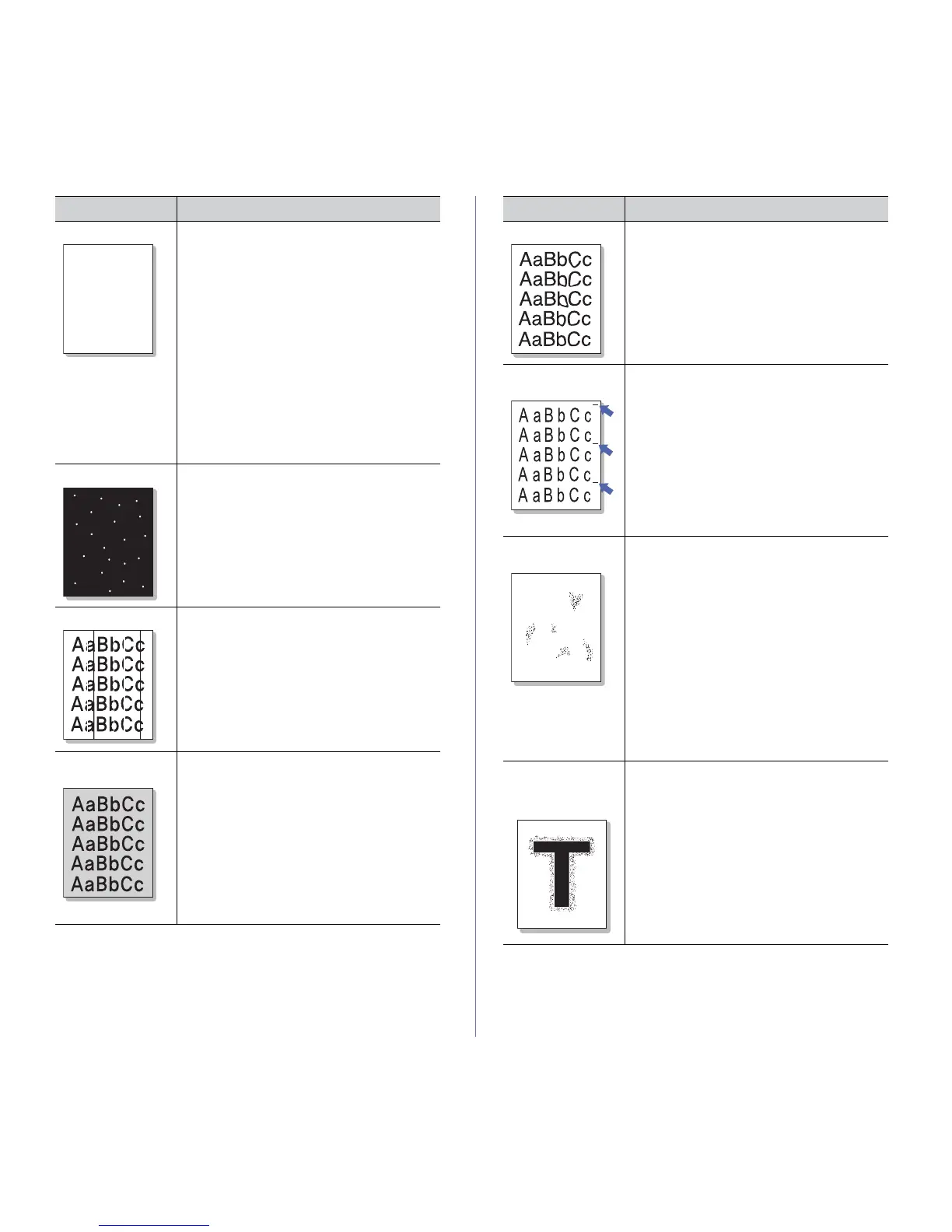
If faded areas, generally rounded, occur ran-
domly on the page:
• A sing
le sheet of paper may be defective.
Try reprinting the job.
• The moisture content of the paper is uneven
or the paper has moist spots on its surface.
Try a different brand of paper (See "Print
media specifications" on page 108).
• T
he paper lot is bad. The manufacturing pro-
cesses can cause some areas to reject
ton
er. Try a different kind or brand of paper.
• C
hange the printer option and try again. Go
to Printing Preferences, click Paper tab,
and set type to Thick (See "Opening printing
preferences" on page 50).
• If th
ese steps do not correct the problem,
contact a service representative.
White Spots
If white spots appear on the page:
• T
he paper is too rough and a lot of dirt from a
paper falls to the inner devices within the
machine, so the transfer roller may be dirty.
Clean the inside of your machine (See
"Cleaning the inside" on page 71).
• T
he paper path may need cleaning (See
"Cleaning the inside" on page 71).
Vertical lines
If black vertical streaks appear on the page:
• T
he surface (drum part) of the imaging unit
inside the machine has probably been
scratched. Remove the imaging unit and
install a new one (See "Replacing the imag-
ing unit" on page 97).
If white vertical streaks appear on the page:
• T
he surface of the LSU part inside the
machine may be dirty (See "Cleaning the
inside" on page 71).
Color or Black
background
If the amount of background shading becomes
unacceptable:
• C
hange to a lighter weight paper (See "Print
media specifications" on page 108).
• Check the environmental conditions: very
dry conditions or a high level of humidity
(higher than 80% RH) can increase the
amount of background shading.
• R
emove the old imaging unit and, install a
new one (See "Replacing the imaging unit"
on page 97). If this problem persists, contact
a service representative.
CONDITION SUGGESTED SOLUTIONS
Toner smear If toner smears on the page:
• Cl
ean the inside of the machine (See "Clean-
ing the inside" on page 71).
• Ch
eck the paper type and quality (See "Print
media specifications" on page 108).
• Remove the imaging unit and then, install a
new one (See "Replacing the imaging unit"
on page 97).
Vertical repetitive
defe
cts
If marks repeatedly appear on the printed side of
the page at even intervals:
• T
he imaging unit may be damaged. If you
still have the same problem, remove the
imaging unit and, install a new one (See
"Replacing the imaging unit" on page 97).
• Parts
of the machine may have toner on
them. If the defects occur on the back of the
page, the problem will likely correct itself
after a few more pages.
• T
he fusing assembly may be damaged. Con-
tact a service representative.
Background scat-
ter
Background scatter results from bits of toner
randomly distributed on the printed page.
• T
he paper may be too damp. Try printing
with a fresh ream of paper. Do not open
reams of paper until necessary so that the
paper does not absorb too much moisture.
• If backgr
ound scatter occurs on an envelope,
change the printing layout to avoid printing
over areas that have overlapping seams on
the reverse side. Printing on seams can
cause problems.
• If
background scatter covers the entire sur-
face area of a printed page, adjust the print
resol
ution through your software application
or in Printing Preferences (See "Opening
printing preferences" on page 50).
Toner particles are
aro
und bold char-
acters or pictures
The toner might not adhere properly to this type
of paper.
• Change the printer option and try again.
Go to the Printing
Preferences, click the
Paper tab, and set the paper type to Recy-
cled.
CONDITION SUGGESTED SOLUTIONS


 To Next Page