Page 27
Defibrillation 4
User Guide Instructions and Safety Notes 4.1
Art. no.: 0-48-0013 Rev. m
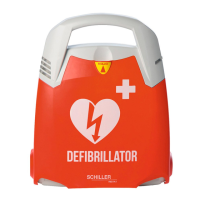
FRED easy
4 Defibrillation
4.1 Instructions and Safety Notes
4.1.1 Instructions
4.1.2 Safety notes for AED use
• FRED easy® is a high-voltage electrotherapy device. Only personnel authorised by
local law are permitted to use these devices. Improper use can endanger life.
• Non medical personnel is only permitted to use an AED such as the FRED easy® if
local law approves of this practice. Make sure that the FRED easy® is only accessi-
ble to persons who are legally authorised to use an AED.
• The success of the defibrillation depends on the correct application of the defibril-
lator but also on the heart's condition. It is the physician's responsibility to decide
about any additional measures (e.g. adrenaline).
• According to AHA/ERC guidelines, even children under 8 years may be defibrillat-
ed.
• The electrodes should be applied in the anterior-anterior position. With infants, an-
terior-posterior placement can be advised to prevent a short-circuit between the
two defibrillation electrodes.
• A defibrillation can fail with certain disease patterns.
Before each use, the user must verify that the device operates reliably and is in
proper working order. It is especially important to check that connection cables
are not damaged. Damaged cables and connectors must be replaced immedi-
ately.
Changes, including concerning operational behaviour, affecting safety must be
immediately reported to the responsible.
Equipment damage! Sensors and devices that are not defibrillation-proof must
be disconnected from the patient before a shock is triggered.
Shock hazard — for patients
In unfavorable situations, the possibility of ECG analysis errors should not be
dismissed. The device must therefore only be used if the following symptoms are
found:
– not responsive,
– no respiration,
– no pulse.
If, in the course of treatment, a patient spontaneously regains consciousness, a
defibrillation shock that may have been advised just before must not be deliv-
ered.



 To Next Page