Page 63
Options 6
User Guide Rechargeable NiCd battery 6.3
Art. no.: 0-48-0013 Rev. m
FRED easy
6.3 Rechargeable NiCd battery
For further details, see 3.1 Inserting the battery.
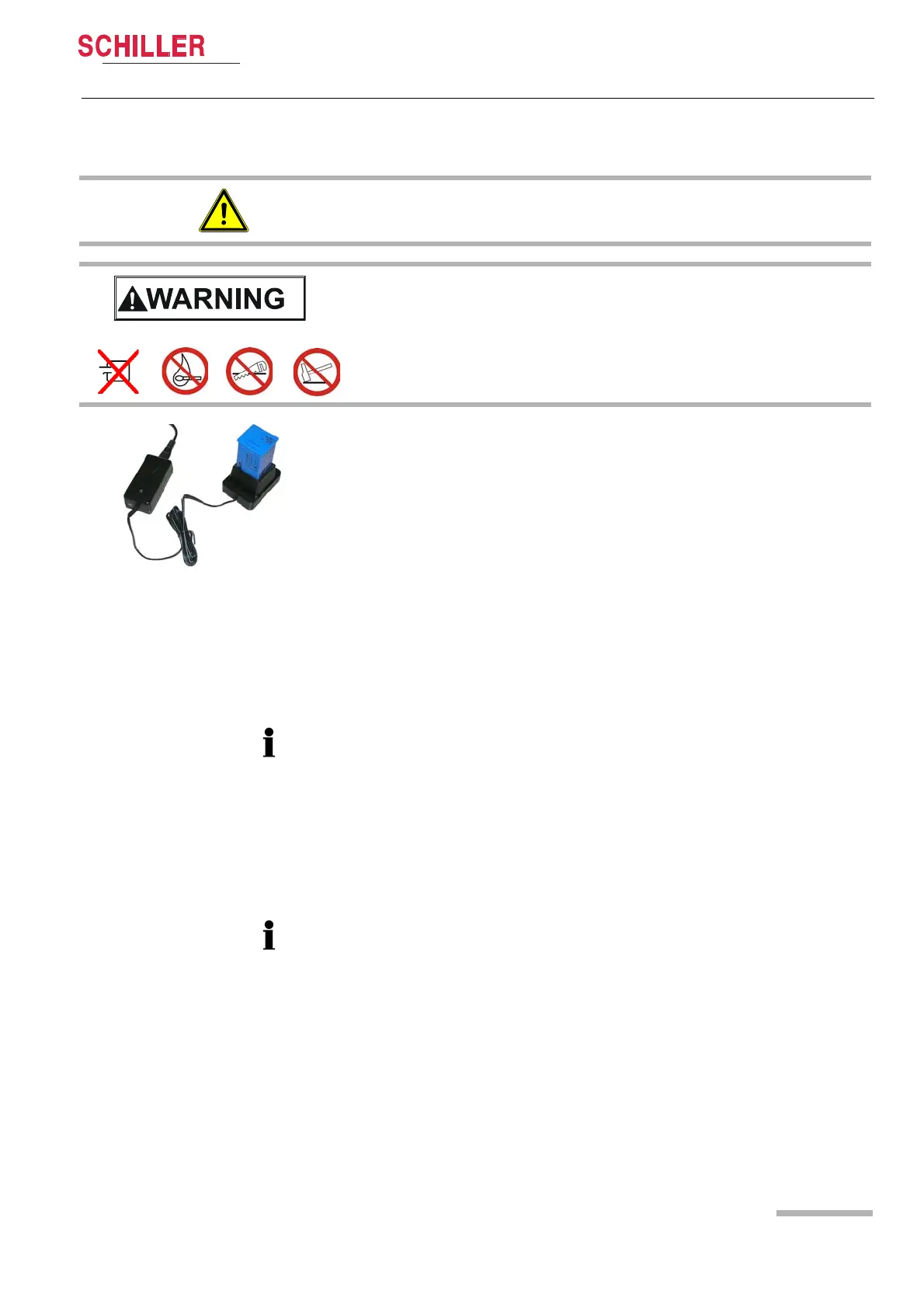
When charging NiCd batteries, make sure to observe the values 100 – 240 V, 50 – 60
Hz (see 9.1 Order Information). The charging time is max. 1 hour.
When the device is equipped with a NiCd battery, it runs a daily self-test.
The battery must remained packed in its original plastic packaging (blister) during the
whole storage time. The plastic packaging must only be removed when the battery is
used.
Danger of explosion! The battery must not be incinerated, exposed to high
temperatures, or disposed with household waste.
Do not expose the battery to chemicals that could dissolve ABS, polypropylene,
polyvinyl chloride, nickel, mylar, or steel.
Do not short-circuit, cut, destroy or incinerate the battery.
As an alternative, a rechargeable NiCd battery (12 V, 650 mAh) is available for the
defibrillator. The capacity of a new, fully charged battery is sufficient for:
– 45 shocks at maximum energy, or
– 40 minutes operating
Like the lithium battery, the device warns the user when the NiCd battery has reached
the "low" battery threshold. The device will still allow the user to perform defibrillation,
but the battery must be recharged/replaced as soon as possible.
The FRED easy® also detects when the NiCd battery is "depleted". In this case, the
device does not allow the user to perform defibrillation and instead prompts him or her
to perform CPR. The battery must be recharged/replaced immediately.
Fig. 6.2 NiCd battery charging unit
• This option is only available for the FRED easy® SD Card and Ethernet versions.
• This option is only available for FRED easy® devices that have a 2nd generation
CPU board.
These devices can be recognised by their 12-digit serial number.
Battery service life — Unused batteries (whether or not inserted in the device) should
be charged at least every 2 months.



 To Next Page