Date Code 20011026 Maintenance and Testing 7-35
SEL-321/321-1 Instruction Manual
The 50QF negative-sequence overcurrent element operates based upon the
magnitude of 3I
2
applied. Using the current connections shown in Figure 7.7, we can
calculate the magnitude of 3I
2
applied based upon the magnitude of I
TEST
.
()
()
()
()
()
°−∠=
−=
−=
−==
++=
++=
90732.1•II•3
aa•II•3
I•aI•aI•3
:so,IIand0I
I•aI•aII•3
I•aI•aI•I
B2
2
B2
BB
2
2
BCA
CB
2
A2
CB
2
A
3
1
2
Because the 50QF element operates based upon magnitude only, the equation above
is simplified.
732.1•II•3
TEST2
=
With a 50QF setting of 0.5 amps, 50QF picks up when I
TEST
is greater than 0.288
amps.
In this example, select │I
TEST
│ = 2.5 amps, thus I
BC
= 5.0 amps and 3I
2
= 4.33 amps.
This selection fulfills the supervisory overcurrent conditions described above.
The reach of the distance element under test is defined by the element setting. In this
case Z2P = 9.36 secondary ohms.
Calculate the magnitude of V
BC
using Equation 7.8.
ondarysecvolts8.46V
36.9•0.5V
Z•IV
BC
BC
BCBCBC
=
=
=
Equation 7.8
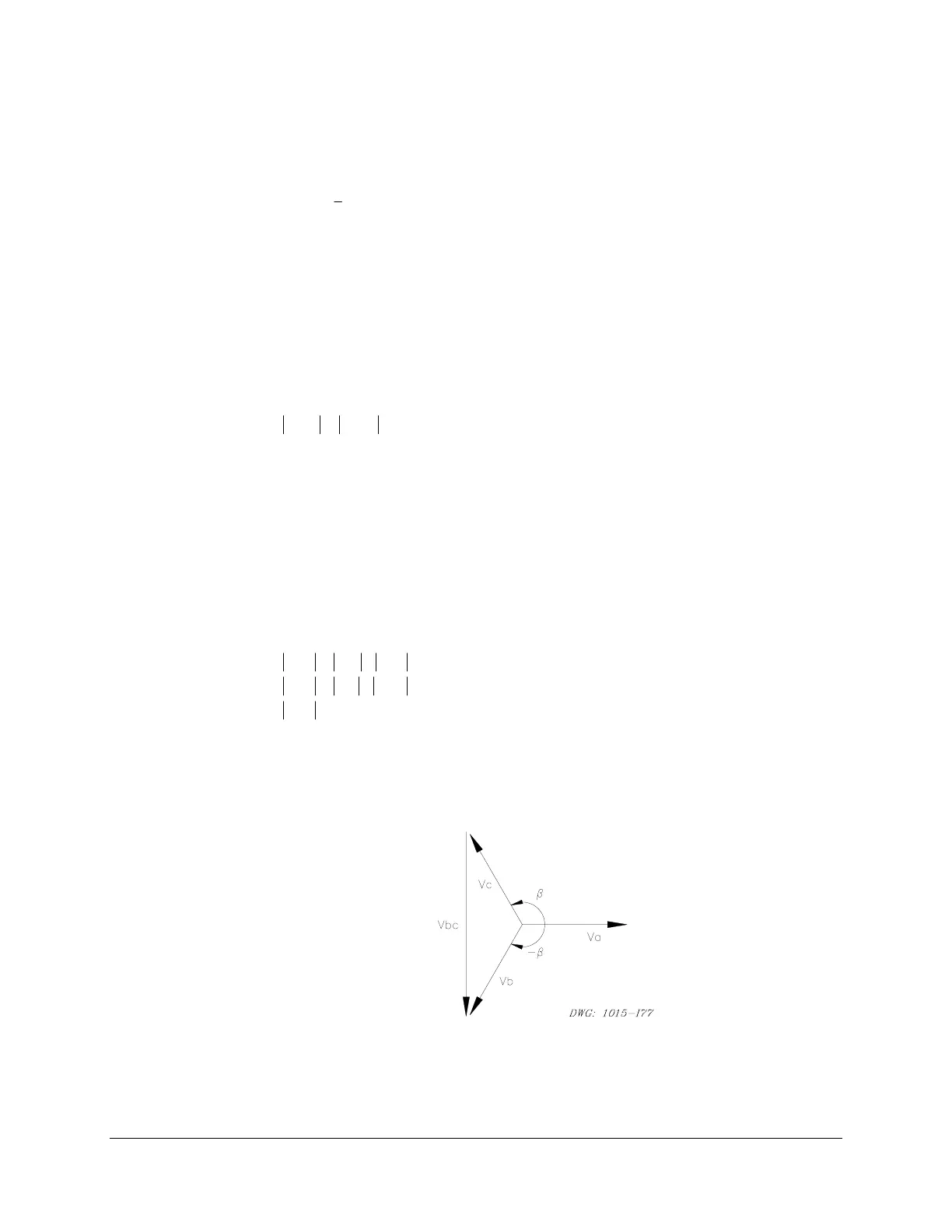
Refer to Figure 7.9 and use the equations below to calculate the magnitude and angle
of V
B
and V
C
based upon the magnitude of V
BC
calculated above.
Figure 7.9: Phase Distance Element Test Voltage Signals
When the magnitude of V
BC
calculated above lies between 67 and 35 volts, use β =
150° and │V
B
│ = │V
C
│ = │V
BC
│.


 To Next Page