User Manual
Chapter 1. Overview
Page 1-16 P/N 2349-72784-00
1.5. Characteristics and Specifications
1.5.1. Receiver Input Specifications
The following tables summarize the features and specifications of the various receiver input
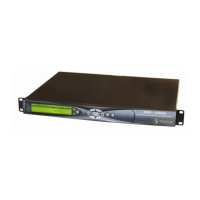
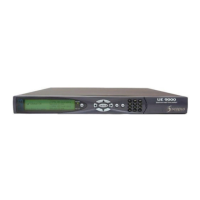
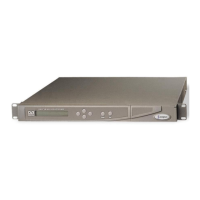
options available for the IRD-2600 and the IRD-2800 Integrated Receiver Decoder:
• QPSK input option, see Table 1-5
• DNSG input option, see Table 1-6
• QAM input option, see Table 1-7
• G.703 input option, see Table 1-8
The decoder is able to receive the following, PDH and SDH, ATM input interfaces as
specified in DVB standards; ETS 300813, for PDH and ETS 300814, for SDH.
The IRD also supports an option for 2 PDH Inputs with loop-trough of the selected input, with
automatic redundancy switching between inputs A & B. Time between switching is controlled.
The specifications of these ATM protocol supporting front-end interfaces are described in
Table 1-9 through Table 1-11.
Table 1-5: QPSK Input Features and Specifications
FEATURE SPECIFICATION
L-Band input 950-2150 MHz
L-Band Loopthrough output 950 – 2150 MHz ± 3dB
Input level -65 to –25 dBm
Symbol Rate 1 - 45 Msymbols/sec continues
Symbol Rate acquisition
range
± 70 ppm
Carrier acquisition range
± 1/4 Symbol Rate
BER (Quasi Error Free after
Reed Solomon)
2 x 10⁻⁴ for Eb/No = 5.5 dB, after Viterbi 3/4
Viterbi Decoding Rates 1/2, 2/3, 3/4, 4/5, 5/6, 7/8, 8/9
Viterbi Constraint Rate 7
Viterbi Rate Recovery Automatic
Reed Solomon decoding 204, 188,
De-interleaving Yes
Digital AGC Yes
LNB Control Voltage: Off, 14V, 18V, (350 mA maximum)
Polarization 22 kHz/Off
Spectral Inversion Automatic


 To Next Page