6. Navigation and Control System
SMF-MP10S User guide V1.1 Shanghai Seer Intelligent Technology Corporation 36
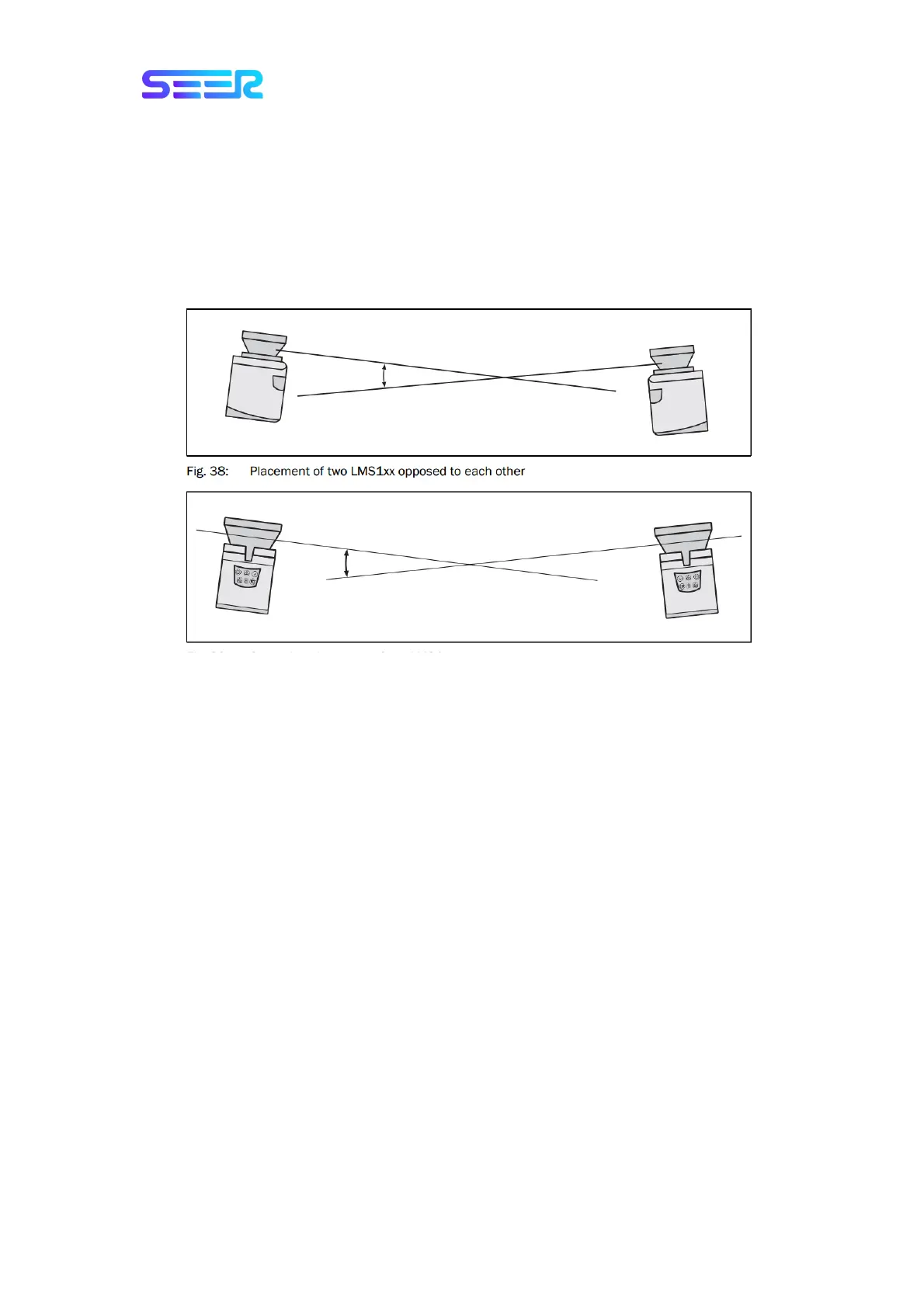
Jamming between Lasers
Generally, the lasers are designed to protect against the jamming between multiple lasers to
avoid mutual jamming. However, the laser manufacturers recommend using the following
installation method to completely avoid mutual jamming between them when using
multiple lasers. The jamming between lasers is eliminated by increasing the tilt angle of the
laser installation. For laser SLAM applications, the tilt angle shall be upward instead of
downward.
Influence of Strong Light
Generally, the ambient light immunity of the indoor laser is about 40klux-80klux, and the
indoor light intensity is usually less than this value. Therefore, the indoor light will not
influence the laser, but it is necessary to avoid direct sunlight as much as possible. For
outdoor applications, please use an outdoor dedicated laser, such as Sick LMS series.
Influence of Environmental Changes on Laser SLAM
The principle of laser SLAM is to build a point cloud map of the environment by scanning the
contour of the environment with the laser radar, and then perform localization and
navigation by matching the built point cloud map with the real-time point cloud scanned
with the laser. Therefore, if the contour of the environment changes significantly (>30%)
after map building, the robot may not achieve the expected high accuracy. If the contour of
the environment changes more significantly (>60%), the robot may deviate from the path or
even lose its localization. Therefore, for the use of laser SLAM in scenes where the
environment often changes significantly, please consider adding other auxiliary measures,
such as enabling online SLAM, deploying reflectors or QR codes.
6.6.2 Obstacle Avoidance Laser
SMF-MP10S is equipped with an OLEI LR-1BS2L laser sensor as obstacle avoidance laser so
that the robot will decelerate and stop when encountering obstacles in the height plane
where the obstacle avoidance laser is installed, thereby improving the safety of the robot in
the movement process. Note: The OLEI LR-1BS2L cannot be used for locating, so the
useForLocalization check must be removed in the robot model file.


 To Next Page