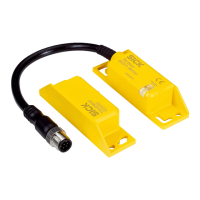
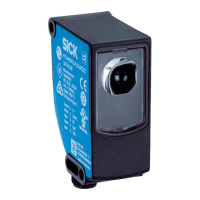
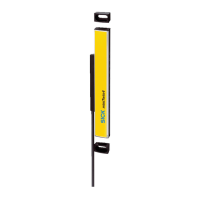
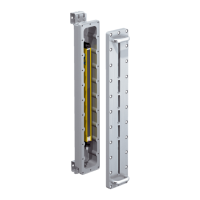
Figure 10: Minimum distance from reflective surfaces
Important information
DANGER
H
azard due to lack of effectiveness of the protective device
Reflective surfaces and dispersive media can prevent persons or parts of the body to
be protected from being properly reflected and, therefore, remain undetected.
►
Make sure that all reflective surfaces and objects maintain a minimum distance
from the protective field.
►
Make sure that no dispersive media (e.g., dust, fog, or smoke) are within the
calculated minimum distance from the protective field.
Determining minimum distance from reflective surfaces with automated calibration of
t
he protective field width
The minimum distance can be determined as follows:
►
Determine the distance between sender and receiver D in meters (m).
►
Read the minimum distance a in millimeters (mm) in the graph or calculate using
the respective formula to determine the minimum distance to reflective surfaces:
1000
900
800
700
600
14 16 18 20 22 242 4 6 8 10 12
500
400
300
200
100
0
0
D/m
a/mm
Figure 11: Graph of minimum distance from reflective surfaces
T
able 9: Formula for calculating the minimum distance to reflective surfaces with automatic
calibration of the protective field width
Distance D between sender and
r
eceiver in m
Calculation of the minimum distance (a) to reflective
surfaces in mm
D ≤3m a = 131mm
D >3m a = tan (2.5°) × 1,000mm/m × D = 43.66 × 1mm/m ×
D
4 PROJECT PLANNING
26
O P E R A T I N G I N S T R U C T I O N S | deTec4 C4P-EAxxx3SC05 8028570/2023-07-27 | SICK
Subject to change without notice



 To Next Page
 Loading...