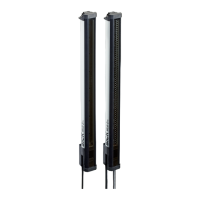
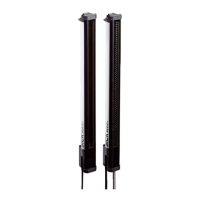
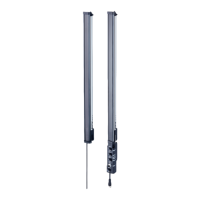
Figure 6: Detection area with beams blanked
1
Included beams
2
Blanked beams
3
Structural restrictions on the detection area
NOTE
One of the t
wo sync beams must be made, both beams may not be blanked at the
same time (see "Measurement principle", page 14).
3.4.6.1 Beam blanking for the MLG-2-Prime
The device can also be set so that beams are blanked during the teach-in.
T
he be
am blanking function blanks the beams that are currently blocked for every
teach-in process (see "System settings on operating level 2", page 45).
NOTE
If an objec
t is located in the detection area during the teach-in process, this will not be
identified as an error.
3.4.7 Sensing ranges
Operating range
Li
ght grids are generally available with a 5 m or 8.5 m sensing range. This is referred to
as the operating range, which includes an operating reserve.
Limiting range
It is also possible to operate the MLG-2 up to its limiting range, which goes beyond the
operating range.
Minimum range
The minimum range is the minimum distance between the sender and the receiver.
Table 10: Limiting range
Operating range Limiting range Minimum range
5 m 7 m 0.2 m
8.5 m 12 m 0.5 m
PRODUCT DESCRIPTION 3
8018715.16YM / 2020-02-13 | SICK O P E R A T I N G I N S T R U C T I O N S | MLG-2 Prime
17
Subject to change without notice



 To Next Page
 Loading...