4 | Section 1
Call processing is sophisticated and flexible. Lines may be readily shared among
studios. A web interface allows easy assignment of lines to “shows”, which can
then be selected by users on the studio controllers. Each studio can provide its own
Program-on-Hold.
Audio processing features also have taken a leap forward. There is a hybrid per line,
allowing multiple calls to be conferenced and aired simultaneously with excel-
lent quality. Each line is also equipped with AGC, automatic EQ processing, and
override ducking.
All connections to the Engine are via two Ethernet jacks that are extended with an
Ethernet switch to support a wide variety of peripherals: telephone lines, Livewire studio
audio, VSet phones, VX Producer PC applications, console-integrated controllers, etc.
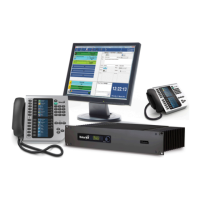
The VSet Phone Controller
While you can control the VX with PC applications and mixing consoles. Most
systems will include one or more Telos VSets. These are the phone-like controllers
that have handsets for off-air conversations.
IP-based Telos VSet phones have large, high-contrast color LCD panels that provide
line status, and caller information. Caller description text that is entered into compat-
ible call screening applications will show up on the LCD near the line select buttons.
For the comfort of familiarity, the VX can work like a traditional Telos controller, with
calls being selected, held, and dropped in the way to which operators have grown
accustomed.
But because the VX system has a hybrid per line, it is often desirable to spread
multiple calls over a number of faders, using one for each call so that operators
can control each line’s level individually. The VSet offers this possibility. It is also
possible to hard-assign individual lines to fixed faders, such as for VIP calls.
VX Producer Windows Software Application
The VX Producer application takes studio phone operations to a higher plane. It
provides the usual call screening functions for phone-active broadcasts – but with
a number of enhancements enabled by the IP nature of the system. The integrated
softphone uncomplicates the producer’s life, since the PC interface is used for all
operations, including answering and making calls, assigning priority, writing notes,
etc. It also reduces cost, as no hardware phone need be installed.
It has a built-in audio recorder/editor. A producer can record and edit a phone call
without leaving the application. The resulting audio files can be easily sent to the
talent PC for quick and convenient airing. We imagine that this simple, but powerful
feature could add an interesting new element to many call-in situations. Callers who
don’t have time to “wait their turn” could be quickly recorded and carefully edited.
Perhaps montages could be created to open segments. Removing the need to wait
might encourage comments from higher-quality callers.
Because Livewire audio is available at the PC via standard LW Driver software, a
producer can readily record calls for later play. These could be edited with a PC
application running on the same machine. When a file has been produced, it can be
sent to the on-air studio over the network.


 To Next Page